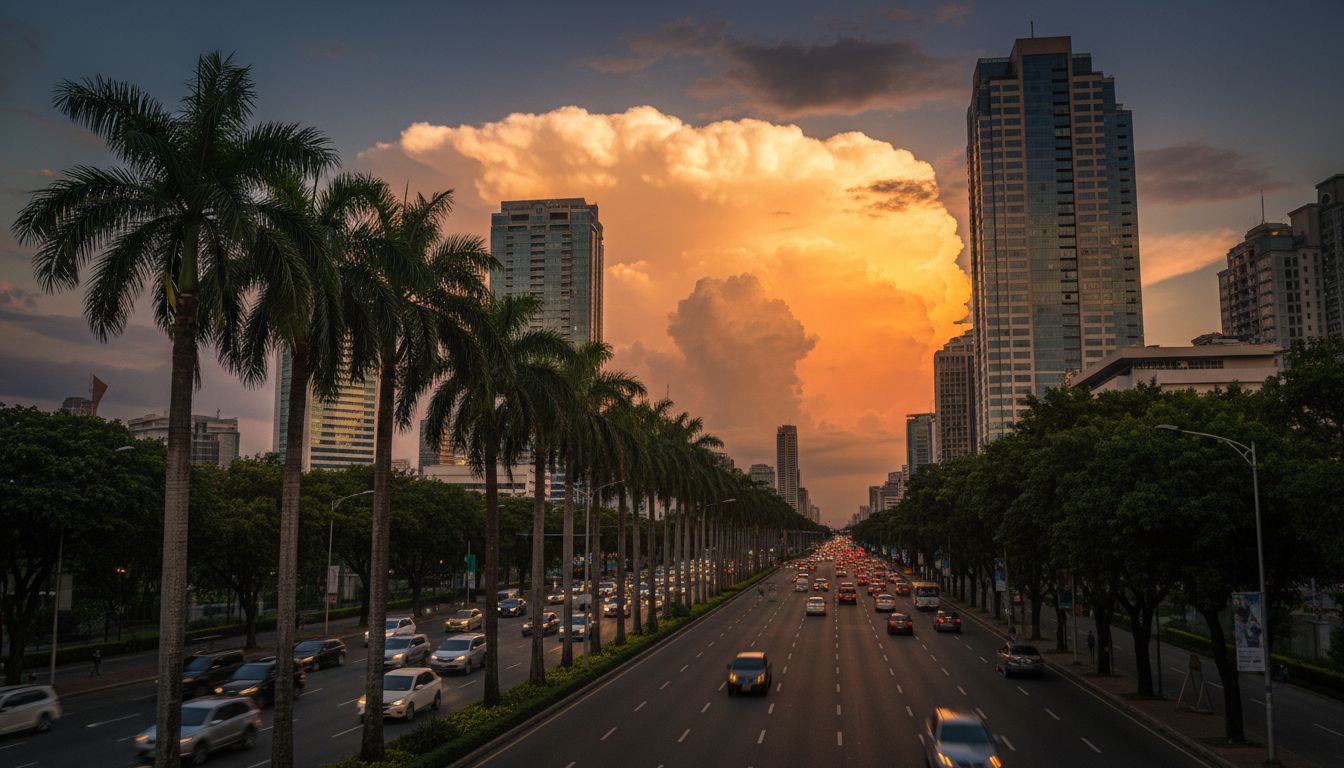
Manila
The capital region, and the only place in the country with the corporate base, the embassies, the specialist hospitals and the long-haul flights. You pay for all of it in commute.
- Best months
- Dec – Feb
- Hardest months
- Jun – Oct
- Getting around
- Three rail lines
- Neighbourhoods
- 5 compared
- Visa
- Country-issued
- Cost data
- Not yet sourced
The Manila guide
Metro Manila is not one city and choosing between its districts is really choosing how much of your life to spend in traffic. Peak travel here runs about twenty-five minutes for every ten kilometres, which turns a distance that looks trivial on a map into an hour each way. Almost everyone who is happy in this city solved that by living inside the district they need to be in and rarely leaving it. Almost everyone who is miserable here commutes across it.
Philippines issues the permission to be here, not Manila — the city does not change what you are allowed to do. Philippines visa programmes →
Which neighbourhood
5 areasBonifacio Global City
Taguig, purpose-builtOur default for a first move. Purpose-built, genuinely walkable, the densest concentration of international offices and restaurants in the country, and the one district where you can live without a daily car.
The catch: The most expensive rent in the Philippines, and it is a bubble — no rail line reaches it, so the moment you need to be anywhere else in the metro you are back in the traffic everyone else deals with.
- Cost, relative
- Highest in the country
- Getting around
- Walk inside it, bus or Grab out
- Who is there
- Multinationals, first-time expats
- Nights
- Polished, ends reasonably
Makati CBD
Salcedo and LegazpiPick it over BGC if you want a city rather than a development: Salcedo and Legazpi are leafy, walkable, full of long-term residents and weekend markets, with the embassies and the banks on the doorstep.
The catch: Near-BGC rents for noticeably older buildings, and the walkability stops hard at the CBD's edge — Poblacion is fifteen minutes on foot and can be forty in a car at the wrong hour.
- Cost, relative
- High, just under BGC
- Getting around
- Walkable core, Grab beyond
- Who is there
- Finance, embassies, long-term expats
- Nights
- Greenbelt, then quiet
Poblacion
Old Makati, off the CBDPick it if the social life is the point. Poblacion has the best independent bar and restaurant scene in the Philippines and is the cheapest way to live inside Makati, in low-rise stock with actual streets.
The catch: The noise is the trade and it is not negotiable — bars running to dawn on the main streets — and it is a real step down from the CBD two blocks away on cleanliness and night-time feel.
- Cost, relative
- Mid, cheapest inside Makati
- Getting around
- Walkable, no rail
- Who is there
- Creatives, younger expats, nomads
- Nights
- The city's best, and relentless
Ortigas & Kapitolyo
Pasig, the middle CBDPick it to stop paying the Makati premium. The third business district has comparable towers and malls at meaningfully lower rents, MRT-3 running through it, and Kapitolyo next door with one of the best food streets in the metro.
The catch: It is cheaper because it is between the two places people actually want to be, and EDSA runs through it — the single worst road in the country to depend on at rush hour.
- Cost, relative
- Below Makati for the same unit
- Getting around
- MRT-3, and EDSA
- Who is there
- Filipino professionals, families
- Nights
- Kapitolyo eats, the CBD sleeps
Quezon City
North, the largest cityPick it for space and price, and to live in a Filipino city rather than an expat district. The largest city in the metro, with the universities, the media industry, real neighbourhoods and rents well below anything south of it.
The catch: Distance is what you are paying with — anything in Makati or BGC is an hour or more each way — and the flooding is severe here, as the 2025 Quezon City floods made plain.
- Cost, relative
- Lowest of the five
- Getting around
- LRT-2 and MRT-3, long trips
- Who is there
- Students, media, Filipino families
- Nights
- Local, late, cheap
The commute is the cost of living here
TomTom measures peak travel in Metro Manila at around twenty-five minutes for every ten kilometres, which puts it near the top of every global congestion table it appears in. That figure is the single most useful number on this page, because it converts distance into hours and hours are what you actually spend.
There are three rail lines — LRT-1, LRT-2 and MRT-3 — and on the routes they cover they are the fastest option at rush hour by a wide margin. The problem is the map: no line reaches Bonifacio Global City, which is where the largest share of foreigners live. Ortigas and Quezon City are the districts where rail is genuinely part of daily life.
So the practical strategy every long-term resident converges on is to live inside the district you need to be in and to structure your week so you cross the metro as rarely as possible. Choosing a cheaper flat forty minutes from your reason for being here is the mistake this city punishes hardest.
Where people work
This is the deepest professional market in the country and it is not close. BGC holds the multinational offices, Makati the finance and legal firms, Ortigas a large share of the outsourcing industry. If your work involves Philippine clients, employers, regulators or an embassy, the case for living anywhere else is weak.
Coworking is correspondingly deep, spread across BGC, Makati and Ortigas at genuinely different price tiers rather than one market rate. Cafes are laptop-friendly across the business districts.
The night-shift economy matters here as it does in Cebu — a large outsourcing workforce runs North American hours, so 24-hour cafes and gyms are normal and the districts do not empty overnight.
What is genuinely bad here
Flooding, and August 2026 is the reference point rather than a historical one: floodwater closed key roads to ordinary cars, La Mesa Dam came within about 0.28 metres of spilling into five further cities, and flights diverted away from Ninoy Aquino International Airport. This is not a once-a-decade event. It is what a bad week in the wet season looks like.
Air. Manila's real-time index sat at 105 — the 'poor' band — when this page was written, and that is ordinary rather than exceptional for the metro. It was the worst air of any city on this site until Jakarta published on 2026-08-26 — Jakarta is now clearly worse — and it remains the single clearest reason someone with a respiratory condition should be looking at Cebu or Baguio instead.
Then the density itself. Metro Manila is one of the most densely populated urban areas on earth and it feels it — noise, crowding, and very little public green space outside the planned districts. People who leave Manila almost never cite one dramatic thing; they cite the accumulation of all of it.
Healthcare here, specifically
This is the strongest argument for the capital and the one that outlasts the others. St. Luke's Medical Center in BGC and Quezon City, Makati Medical Center and The Medical City in Pasig are the top of the Philippine system — the specialist tail that every other city in the country, Cebu included, eventually refers into.
Care is in English, standards at these hospitals are genuinely international, and complex oncology, cardiac and neurological work is handled here rather than evacuated abroad. For anyone weighing this country with an existing condition, that is a real and specific reason to be in Manila rather than anywhere else in it.
They still bill upfront. Philippine private hospitals routinely want a deposit or a guarantee before admission, and PhilHealth — which SRRV holders may join — reimburses a fraction of private rates. We are not publishing consultation prices: the figures circulating come from clinic-listing aggregators rather than the hospitals themselves.
How people actually find a place, and what the terms mean
Lamudi and Dot Property carry the listings, agents carry the rest, and in the condo towers a large share of units are let by individual owners through building administrators and Facebook groups rather than through either portal.
The entry cost is the part that catches people out. Leases here are quoted as "1-2" or "2-2" — months of advance rent, then months of security deposit — with two months deposit plus one month advance the common arrangement. On a Makati or BGC one-bedroom that is a substantial sum handed over before you hold a key, and it is worth knowing before you shortlist on monthly rent alone.
We are not going to point you at a listings page and call it an answer. The portals and the agents own that transaction and they bid hard for it; the useful thing is the shape of the deal, which nobody explains until you are in an office being asked for the money.
The visa is the country's, not the city's
Living in Manila is not a different permission from living anywhere else in the Philippines. The route we hold a full record for is the SRRV, the retirement visa — permanent residency on issue, and it exempts its holder from needing a separate work or student permit.
The deposit levels, the age bands and the government page they were checked against are on the Philippines guide and the visa record linked from this page. The one genuinely Manila-specific detail: the Bureau of Immigration's main office and every embassy in the country are here, so any process that turns out to need a person rather than a portal is easier from this city than from anywhere else.
What we have not sourced, and why the rows are blank
Manila shows the problem more clearly than anywhere else on this site. Dot Property reports 7,945 Makati condo listings and serves a cold request ten of them, all marked featured — six being three- and four-bedroom apartments at 180,000 to 275,000 pesos a month in Rockwell and Bel-Air. Two one-bedrooms appear at 33,000 and 40,000. Lamudi refuses automated reads outright.
Featured placement is paid. Averaging that set would put Makati's rent several times above what people actually pay, and it is exactly the kind of number that ends up quoted as a city average once somebody publishes it. The cost-of-living sites all carry a Manila figure; none of them tells you which listings it came from.
So the rows stay blank and say why. They publish at five dated resident submissions naming the district and whether the unit is furnished — the box under the table is where those go.
What a month costs
2 unsourcedSame two-portal wall as Cebu, and Makati shows the bias more clearly than anywhere: Dot Property reports 7,945 Makati condo listings and serves a cold request ten FEATURED units, of which six are three- and four-bedroom apartments at PHP 180,000–275,000 a month in Rockwell and Bel-Air. Two one-bedrooms appear, at PHP 33,000 (39 sqm, San Lorenzo) and PHP 40,000 (59 sqm, Bel-Air). Featured placement is paid, so this set is an advertisement and it skews high by construction — averaging it would put Makati's rent several times above what people actually pay. Lamudi returns HTTP 403 to automated reads. Checked 2026-08-25. Publishing at five dated resident submissions.
Metro Manila has the deepest coworking market in the country, spread across BGC, Makati and Ortigas at genuinely different price tiers. The rates we could reach were aggregator round-ups quoting operators rather than the operators' own pricing pages, which is the same wall Bangkok's row hit. A second-hand price is not a source. Pending a direct check.
2 of these lines have no figure yet.
That is deliberate. We publish a cost line when we have a source we would stand behind and a date we checked it, and leave it blank when we don't — rather than averaging numbers we never verified, which is what the figure you'll find elsewhere usually is. If you live in Manila, these gaps are where a correction is worth the most.
Live in Manila? Tell us what you actually pay.
One field is enough. No account, no email — we're collecting figures, not reviews, and a real number from one resident beats an average scraped from nobody.
Practical
Three rail lines — LRT-1, LRT-2 and MRT-3 — and they are the fastest thing at rush hour on the routes they cover. The catch is that they do not cover BGC, so the district most foreigners live in is the one the trains miss. Grab is the default and surges hard in rain.
Area-dependent in a way Cebu is not. The business districts are comfortable and heavily secured; parts of the wider metro are not, and the gap between two adjacent barangays can be large. Standard practice is Grab rather than street taxis at night, and not carrying a phone in your hand in traffic.
Philippine Peso. Card acceptance is the best in the country and QR payment is everywhere, but a peso bank account still effectively needs an ACR I-Card, which needs a stay over 59 days. Plan the first two months on foreign cards and remittance apps.
The best-served market in the country — fibre from Converge, Globe and PLDT across the business districts, and Converge topped Ookla's national fixed-broadband ranking for the first half of 2026. Ask which providers reach the specific unit, and budget for a mobile backup: power cuts and storm outages are routine.
Common questions
Which area of Manila should I live in?
Bonifacio Global City for a first move — walkable, modern, the easiest landing, and the most expensive rent in the country. Makati's Salcedo and Legazpi villages give you an established city rather than a development at slightly lower cost. Poblacion is the cheapest way to live inside Makati and has the best bars and restaurants in the Philippines, with the noise that implies. Ortigas and Kapitolyo are the value play with MRT-3 running through them. Quezon City is the cheapest and the furthest from everything else.
Is Manila worth it compared with Cebu?
Only for specific reasons, and they are worth naming because for most people the answer is Cebu. Manila wins on three things: the corporate, embassy and regulatory base; the specialist medical tail at St. Luke's, Makati Medical and The Medical City, which the rest of the country refers into; and long-haul flight choice. Cebu wins on everything else — far milder traffic, cleaner air and the sea half an hour away. If your reason for being in the Philippines does not involve one of Manila's three, Cebu is the better base.
How bad is Manila traffic really?
Peak travel runs about twenty-five minutes for every ten kilometres on TomTom's measurement, which places Metro Manila near the top of global congestion rankings. In daily terms a trip that looks like twenty minutes on a map is an hour. Three rail lines — LRT-1, LRT-2 and MRT-3 — beat the roads where they run, but none of them reaches Bonifacio Global City, where most foreigners live. The workable strategy is to live inside the district you need and cross the metro as rarely as possible.
Does Metro Manila flood?
Badly, and recently. In August 2026 floodwater closed key roads to ordinary cars, La Mesa Dam came within roughly 0.28 metres of spilling into five more cities, and flights diverted away from Ninoy Aquino International Airport. Quezon City saw severe flooding in 2025. This is a normal feature of the June-to-October wet season rather than a rare event, and the ground floor of a building matters more here than the view from the top of it.