Baguio
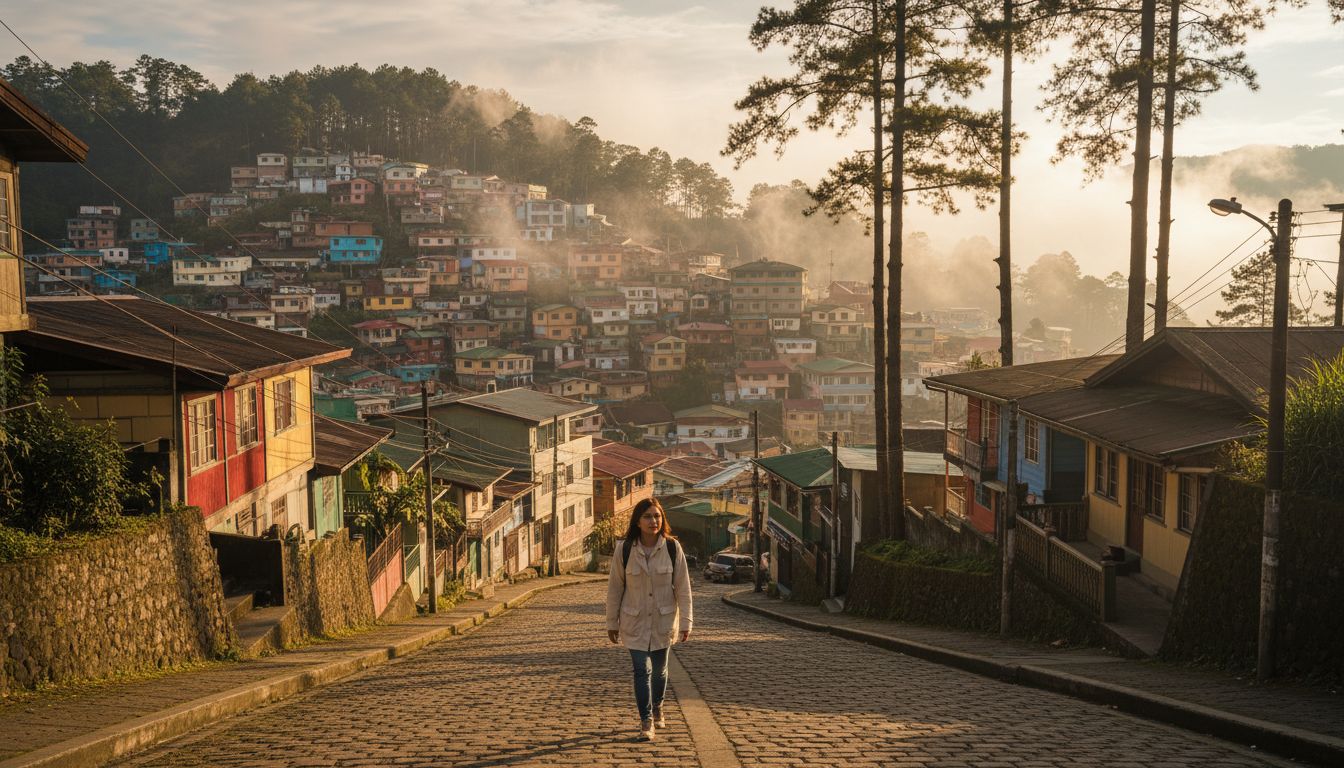
The only city in the Philippines that is not hot — around 1,300 to 1,500 metres up, with monthly averages in the high teens. It is also rationed for water, gridlocked for its size, and the wettest place on this site.
- Best months
- Nov – Apr, dry
- Hardest months
- Jul – Aug, extreme rain
- Getting around
- Walk the centre, jeepneys
- Neighbourhoods
- 5 compared
- Visa
- Country-issued
- Cost data
- Not yet sourced
The Baguio guide
Baguio exists on this site for one reason and it is a good one: it is the only city in this whole vertical where you will want a jacket. At roughly 1,300 to 1,500 metres the monthly averages sit between about 18 and 21°C all year, which nowhere in Thailand, Malaysia, Vietnam or Indonesia can offer. Everything else on this page is the price of that, and two parts of the price — the water and the traffic — are things almost nobody tells you before you arrive.
Philippines issues the permission to be here, not Baguio — the city does not change what you are allowed to do. Philippines visa programmes →
Which neighbourhood
5 areasSession Road area
The city centreOur default pick if you want a car-free life. The commercial spine, the market, the cafes and the hospitals are all inside a walk, which in a city this congested is worth more than space.
The catch: This is where the congestion concentrates and where the weekend tourist volume lands. Older buildings, thin parking, and noise from a road network that has been over capacity since the 1990s.
- Cost, relative
- Highest, on location
- Getting around
- On foot, steeply
- Who is there
- Students, workers, everyone
- Nights
- Busiest in the city, still modest
Camp John Hay
South, the old US basePick it for the trees. The former American rest-and-recreation base is the greenest and quietest address in the city, with the best-maintained housing stock and the pine cover that made Baguio's reputation.
The catch: You are paying a large premium for calm, and it is an enclave — nothing is a walk except within the grounds, and the leasehold arrangements on parts of the estate are worth reading closely before committing.
- Cost, relative
- Highest of the five
- Getting around
- Car or taxi to the centre
- Who is there
- Wealthier residents, second homes, retirees
- Nights
- Restaurants inside the estate, quiet
South Drive & Outlook Drive
The ridge above the centrePick it for a house with a view that is still close in. The ridge roads hold Baguio's older detached housing, quieter than the centre and close enough to walk down to it, if not back up.
The catch: The gradient is the whole experience and it is unforgiving in the rain. Housing stock is old, some of it predates the 1990 earthquake, and slope stability is a real question to ask about any specific property.
- Cost, relative
- High, on houses
- Getting around
- Walk down, taxi back
- Who is there
- Established families, long-term residents
- Nights
- Residential, nothing local
Loakan & the south
By the airport and the economic zonePick it for value and air. The southern barangays around Loakan sit away from the congested core, next to the export processing zone that provides much of the city's non-tourism employment.
The catch: Distance from everything Baguio is actually good at, thin amenities, and a jeepney ride into the centre that becomes a long one whenever the city is busy — which is most weekends.
- Cost, relative
- Low
- Getting around
- Jeepney or car, a real trip
- Who is there
- Zone workers, local families
- Nights
- Local, early, sparse
La Trinidad
Next municipality, 15 minutes northPick it to get more space for the money. La Trinidad is Benguet's capital and a separate municipality, contiguous with Baguio's northern edge — the strawberry farms, the wholesale vegetable trade, a large student population and materially cheaper housing.
The catch: It is a different local government with its own services, the single road corridor into Baguio jams hard at peak, and it is lower and slightly warmer than the city proper — so you give up a little of the one thing you came for.
- Cost, relative
- Lowest of the five
- Getting around
- Jeepney along one corridor
- Who is there
- Students, farming families, commuters
- Nights
- Local and early
The cool climate is real, and it is the entire argument
Baguio sits at roughly 1,300 to 1,500 metres, and the numbers are the point: the coldest month averages about 18°C and the warmest about 21°C. That is a narrow band and it is the same all year, which makes this the only city in this vertical where heat is not a factor in how you plan a day.
The Philippines has called it the summer capital since the American period for exactly that reason, and the effect on daily life is larger than a three-degree difference sounds. Air conditioning is not standard here because it is not needed; sleep is easier; and the walking that is unpleasant at noon in Cebu or Manila is simply walking.
If heat is the thing that would send you home from Southeast Asia, this page is the answer to that specific problem and there is no second option on this site. Everything below is what you trade for it.
The water is rationed, and has been since the 1980s
This is the fact that belongs at the top of every Baguio relocation guide and appears in almost none of them. The city's water supply has been rationed since the 1980s: most neighbourhoods receive their allocation on certain days of the week rather than continuously, while the business and tourism centres are kept supplied during business hours.
In practice that means storage. Households run tanks and drums and fill them on their day, and 'which days does this building get water' is a question you ask a landlord before you ask about the rent. It is normal here and residents manage it without drama, but arriving without knowing is a genuinely bad first week.
It is also structural rather than a bad year. A 2019 urban carrying capacity study found Baguio had already breached its thresholds on water supply along with road density, green cover, land for settlement, forest cover, open spaces and both liquid and solid waste. Tourism adds demand on exactly the days supply is tightest, which is why proposals to tax or cap visitors keep returning.
What is genuinely bad here
The traffic, and the arithmetic is worse than the experience of any city this size should be. Baguio's road network was built for something like 15,000 to 20,000 vehicles and there were roughly 58,000 registered in the city as of 2024, before tourists add an estimated 25,000 more on a busy weekend. The network's carrying capacity was breached as long ago as 1994. The city has floated a daily cap of 20,000 leisure visitors and a congestion fee, and both proposals draw the objections you would expect from a tourism economy.
Then the rain, which is not a figure of speech. Baguio is the wettest place on this site — the annual total lands near 3,900 mm on the series our Philippines guide cites, and other climate series put it lower, but the number that settles the argument is that August alone averages over 900 mm. July and August are not a rainy season in the Southeast Asian sense of afternoon storms; they are weeks of it.
And the ground. The 7.7-magnitude Luzon earthquake of 16 July 1990 hit Baguio harder than anywhere else — the Hyatt Terraces Plaza collapsed and killed around fifty people, all three of the city's hospitals were damaged with Baguio General's roof coming down, and hundreds of buildings were lost. Combined with steep slopes and heavy rain, that makes the age and siting of a specific building a real question here rather than a pedantic one.
Healthcare here, specifically
Baguio is the healthcare centre for the Cordillera region and northern Luzon, which means it is far better served than a city of 368,000 would normally be — people come down from the mountain provinces for care that does not exist there. Baguio General Hospital and Medical Center is the public tertiary referral hospital; Saint Louis University Hospital of the Sacred Heart, Notre Dame de Chartres and Pines City Doctors' Hospital are the private options most foreigners end up using.
What that does not make it is a specialist centre. Complex cardiac, oncological and neurological work still goes to Manila, which our Manila page describes from the other end — the specialist tail there is what the rest of the country refers into, Cebu included. From Baguio that referral is a four-to-six-hour road journey rather than a flight, because the city's own airport does not carry scheduled commercial traffic.
That distance is the thing to price. For anything routine Baguio is comfortable and cheap; for anything serious the plan is a long drive to a private Manila hospital that bills upfront, and PhilHealth reimburses a fraction of private rates.
How people actually find a place, and what the market actually is
Lamudi and the local Facebook groups carry most of what is available, and in Baguio the groups matter more than the portals do — this is a small market where a lot of units never get listed at all and word of mouth through the university and church networks does the work.
The thing to understand before you compare anything is what the rental stock actually is. Baguio is a university city with something on the order of a hundred thousand students, and a large share of its housing is bedspace, shared rooms and student units let by the academic term. A cheap headline figure for 'Baguio rent' is usually describing that, not a self-contained one-bedroom, and the two markets barely overlap.
Lease terms follow the Philippine norm — advance rent plus a deposit, typically quoted as months of each — and the student market runs on the school calendar, so June and the weeks around it are when the self-contained units get taken and when a foreigner arriving off-cycle has the most leverage.
The visa is the country's, not the city's
Living in Baguio is not a different permission from living in Cebu or Manila. The routes are the SRRV retirement visa, which grants permanent residency on issue, and the Philippine Digital Nomad Visa created by Executive Order 86 — whose text, notably, states no income figure at all. Both records and the government sources behind them are linked from this page.
The one Baguio-specific consequence is administrative distance. The Bureau of Immigration's main office and every embassy in the country are in Manila, and Baguio is a four-to-six-hour road trip from them with no scheduled flights. Any process that turns out to need a person rather than a portal costs a day here in a way it does not in the capital.
What we have not sourced, and why the rows are blank
Both rows are blank. Baguio is poorly served by the Philippine portals: Lamudi Philippines returns 401, Rentpad returns 403, and Dot Property does not have a Baguio apartment path at all — it 404s. All checked on 26 August 2026. There is no government rent series for the Philippines to fall back on.
The student-housing distortion above is the second reason, and it is the one that would make a scraped figure actively misleading rather than merely thin. Any average taken across this market blends bedspaces let by the term with self-contained apartments, and the resulting number describes neither. That is the same shape of error as Manila's, where a portal served ten paid featured listings out of 7,945.
Coworking is blank because Baguio's market is small and cafe-led, and nothing publishes a monthly rate on its own site. Kuala Lumpur's row publishes because an operator posted its own figure — that is the bar. These rows publish at five dated resident submissions naming the barangay and whether the unit is furnished; the box under the table is where those go.
What a month costs
2 unsourcedBaguio is poorly served by the Philippine portals, and worse than Cebu or Manila because it is a smaller market: Lamudi Philippines returns HTTP 401, Rentpad 403, and Dot Property has no Baguio apartment path at all — it 404s (checked 2026-08-26). No government rent series exists. Baguio also has a distortion the other two Philippine cities do not: this is a university city with roughly a hundred thousand students, so a large part of the rental stock is bedspace and shared units let by the term, and a headline 'Baguio rent' usually describes that market rather than a self-contained one-bedroom. Publishing at five dated resident submissions naming the barangay and whether the unit is furnished.
Not sourced. Baguio's coworking market is small and cafe-led rather than operator-led, and none of the spaces we could reach publishes a monthly rate on its own site. Checked 2026-08-26. Kuala Lumpur's row publishes because an operator posted its own figure — that is the bar, and an aggregator's number is not a source.
2 of these lines have no figure yet.
That is deliberate. We publish a cost line when we have a source we would stand behind and a date we checked it, and leave it blank when we don't — rather than averaging numbers we never verified, which is what the figure you'll find elsewhere usually is. If you live in Baguio, these gaps are where a correction is worth the most.
Live in Baguio? Tell us what you actually pay.
One field is enough. No account, no email — we're collecting figures, not reviews, and a real number from one resident beats an average scraped from nobody.
Practical
The centre is genuinely walkable and genuinely steep — this is a mountain city and the shortcuts are stairways. Jeepneys cover the barangays cheaply, taxis are metered and plentiful by Philippine standards, and there is no rail. Owning a car here is more liability than asset given the parking and the congestion.
One of the easier cities in the country on this count and noticeably calmer than Manila. The realistic hazards are environmental rather than criminal: steep wet roads, landslide-prone slopes in the rainy months, and the fog that can cut visibility on the highways in and out.
Philippine Peso. Card acceptance is decent in the malls and the chains and thin everywhere else — the markets, the jeepneys and most small eateries are cash. A peso bank account still effectively needs an ACR I-Card, which needs a stay over 59 days, exactly as in Manila.
Fibre reaches the built-up areas and the university districts, but the terrain makes this a street-by-street question rather than a district-wide one, and the same storms that flood the lowlands take lines down here. Budget for a mobile backup and ask which providers physically reach the building.
Common questions
Is Baguio actually cold?
Cool rather than cold, and consistently so, which is the useful part. At roughly 1,300 to 1,500 metres the coldest month averages about 18°C and the warmest about 21°C, so the range across the whole year is a few degrees. Air conditioning is not standard in Baguio housing because it is not needed, and a jacket in the evening is. It is the only city on this site where heat does not shape the day, and if heat is the thing that would send you home from Southeast Asia, there is no second option here.
Does Baguio have water problems?
Yes, and it is the single most important thing to know before moving here. Baguio's water supply has been rationed since the 1980s: most neighbourhoods receive their allocation on set days of the week rather than continuously, while business and tourism areas are supplied during business hours. Households run storage tanks and fill them on their day. Ask a landlord which days a specific building receives water before you ask about the rent. A 2019 carrying-capacity study found the city had already breached its thresholds on water supply along with roads, green cover, forest cover, open space and waste.
How bad is Baguio traffic?
Disproportionate to the size of the city. The road network was built for roughly 15,000 to 20,000 vehicles and the city had about 58,000 registered as of 2024, with an estimated 25,000 more brought in by tourists on a busy weekend. Its carrying capacity was breached as early as 1994. Baguio has floated a daily cap of 20,000 leisure visitors and a congestion fee, both contested. The practical answer for a resident is to live somewhere you can walk from and not to own a car.
Is Baguio a good base compared with Cebu or Manila?
It is the right answer to one specific question and the wrong answer to most others. Baguio wins outright on climate — nowhere else in this vertical is cool — and on cost, calm and walkability in the centre. It loses on everything that needs scale: no commercial airport, a four-to-six-hour road trip to Manila for specialist medicine, immigration and embassies, a small professional scene, and a rental market built around students. Cebu is the better all-round base and Manila the better place to need an institution. Choose Baguio because of the temperature, not in spite of it.