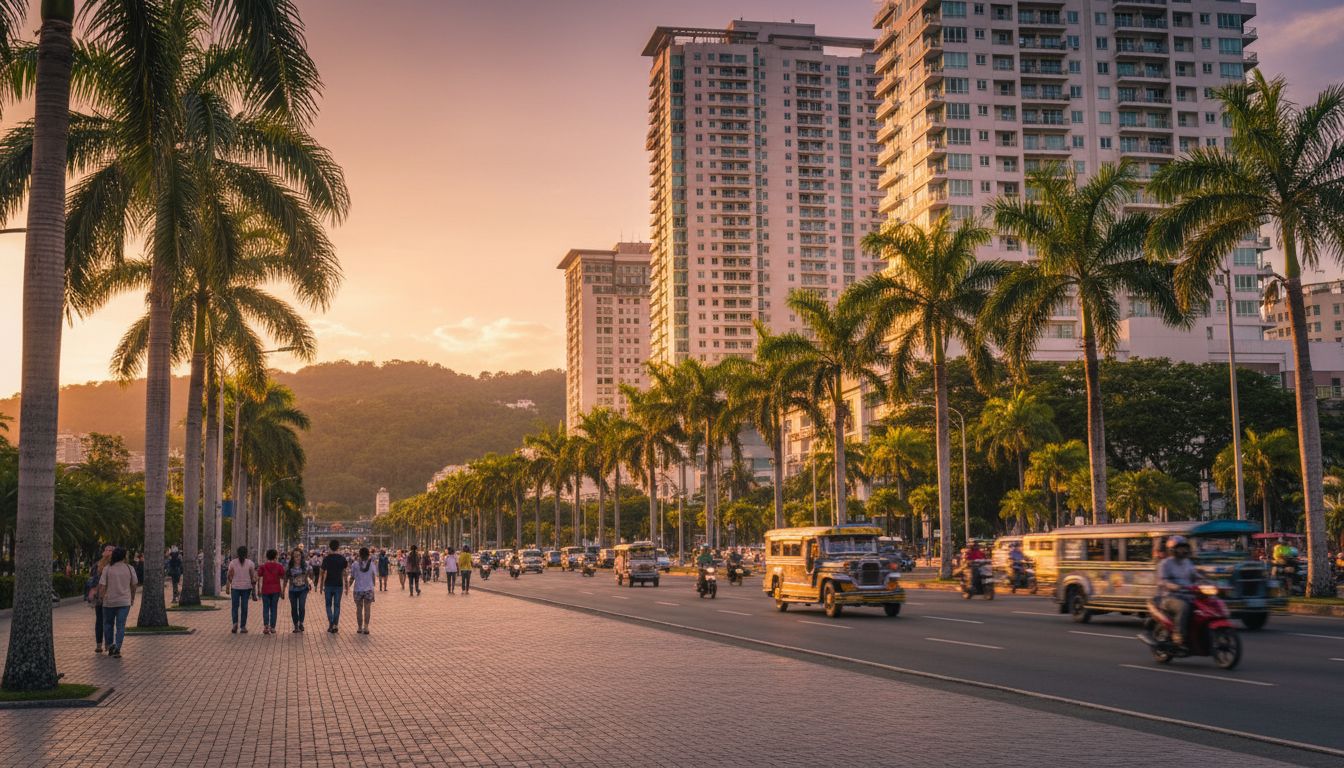
Cebu City
The Philippines' second city and its usable one — the airport, the hospitals and the professional scene without Manila's commute, on an island that sits squarely in the typhoon path and is short of water.
- Best months
- Jan – May
- Hardest months
- Jun – Nov
- Getting around
- Grab, no rail
- Neighbourhoods
- 5 compared
- Visa
- Country-issued
- Cost data
- IT Park rent sourced
The Cebu City guide
Cebu is the Philippines' second city and the one most foreigners end up in, for a reason that survives contact with the place: it has the international airport, the private hospitals and the professional scene, and none of them cost you Manila's commute. What it does not have is a single metre of urban rail. That absence is the whole page — with no line to organise your life around, the district you pick is the decision, because it determines how much of your week you spend in a car.
Philippines issues the permission to be here, not Cebu City — the city does not change what you are allowed to do. Philippines visa programmes →
Which neighbourhood
5 areasCebu IT Park
Apas, north of centreWhere most remote workers land and most stay. A compact, walkable estate of condos, cafes, coworking and BPO towers with the best internet in the city, and the only part of Cebu where a car is genuinely optional.
The catch: The highest rents in Cebu, almost no green space, and the noise is structural rather than occasional — the call-centre shifts mean the district genuinely never sleeps and the bars are built around that.
- Cost, relative
- Highest in the city
- Getting around
- Walkable inside, jammed at the gates
- Who is there
- BPO staff, remote workers, young
- Nights
- Late, loud, every night
Cebu Business Park
Central, around AyalaPick it for a short walk to the city's main mall, the banks and the consulates, in the most polished housing stock Cebu has. The obvious choice if your reason for being here involves other people's offices.
The catch: You pay a premium for proximity to a shopping centre, and the district empties in the evening into something closer to an office park than a neighbourhood.
- Cost, relative
- High, corporate pricing
- Getting around
- Walk to the mall, Grab beyond it
- Who is there
- Corporate expats, Filipino professionals
- Nights
- Mall hours, then empty
Banilad & Talamban
North, up the hillPick it for room to live rather than a unit to sleep in: houses as well as condos, the international schools, real supermarkets, and noticeably more square metres for the money than IT Park.
The catch: Everything is a drive, so a car or a standing Grab budget stops being optional — and the hill roads are where heavy rain does its worst, with flash flooding and landslip closing routes into town.
- Cost, relative
- Mid, most space per peso
- Getting around
- Car or Grab, hilly
- Who is there
- Families, retirees, university staff
- Nights
- Residential, ends early
Mactan
The airport islandPick it to live by the water. Technically Lapu-Lapu City rather than Cebu City, this is the resort and diving side, with the international airport on it — unbeatable if you fly often or the sea is why you came.
The catch: Two bridges carry everything between the island and the city, so one accident turns a half-hour trip into two hours. Add aircraft noise on the approach side, and the fact that the ordinary city — hospitals, offices, most of your errands — is on the other side of that bottleneck.
- Cost, relative
- Widest range of the five
- Getting around
- Car essential, bridges bottleneck
- Who is there
- Divers, retirees, airline crew
- Nights
- Resort bars, spread thin
Downtown & Colon
The old port cityThe oldest part of the city and the only genuinely cheap option on this list — dense, Cebuano-speaking, market-driven, and the place to live if the point of moving was not to live among other foreigners.
The catch: Rough after dark in a way the other four are not, the worst of the city's flooding sits here, and the housing stock is old in the difficult sense rather than the characterful one.
- Cost, relative
- Lowest of the five
- Getting around
- Jeepney and walking
- Who is there
- Cebuano residents, almost no foreigners
- Nights
- Shuts early, thin after dark
No rail, which is why the district is the decision
Cebu has no metro, no light rail and no commuter line. A bus rapid transit project has been announced, re-announced and re-costed for more than a decade and is not carrying passengers. Everything moves by Grab, taxi, jeepney or private car on the same roads.
Compare that with Bangkok, where the answer to "where should I live" is "near a BTS or MRT station" and the rest follows. Cebu has no such organising line, so the question becomes how much of your week you are willing to spend in traffic — and that is answered by which of the five districts above you pick, not by which building.
The upside is real and it is the reason people choose this city over Manila: the distances are short and the congestion, while bad, is a different order of magnitude. A cross-city trip here is inconvenient. In Metro Manila it is the day.
Where people work
IT Park is the centre of gravity and it exists because of the outsourcing industry rather than because of nomads — which is why the infrastructure is unusually good for a city this size. Fibre, redundant power in the office towers, 24-hour cafes, and a working population that is awake at the same time as clients in North America.
Coworking is concentrated in IT Park and the Business Park, with a smaller cluster on Mactan aimed at the resort crowd. Cafes are laptop-tolerant in the modern districts and much less so downtown.
The night-shift culture is worth understanding before you sign a lease. A large share of the professional population here works North American hours, so the city's rhythm is genuinely 24-hour in the BPO districts — convenient if your clients are in the US, and a noise problem if they are not.
What is genuinely bad here
Water. This is not a background grumble, it is the live 2026 story: the Metropolitan Cebu Water District has been reporting a daily shortfall of roughly 16,000 cubic metres against demand near 280,000, and in June 2026 the city was publicly weighing a state-of-calamity declaration over it. In practice that means scheduled interruptions and pressure loss, worse the higher up the hill you live. Ask a prospective building whether it has a cistern and a pump, and treat a shrug as an answer.
Flooding, and it is the same story from the other end. Heavy rain on 30 July 2026 put floodwater three to six feet deep in parts of Barangay Tisa, and the city's own explanation is that natural channels have been narrowed from six or ten feet down to about three by construction, with unchecked runoff coming off the uplands. A city short of stored water that floods every heavy rain is not a contradiction — it is the same missing infrastructure seen twice.
Then the typhoons, which are the reason to take the first two seriously. Cebu sits in the path rather than beside it. Typhoon Odette crossed the island in December 2021 and left parts of the city without power or running water for weeks — not hours. Whatever you plan here, plan for that happening again.
Healthcare here, specifically
Better than most cities this size, and it is one of the strongest arguments for Cebu over anywhere else in the country outside Manila. Chong Hua, Cebu Doctors' University Hospital and Perpetual Succour are the hospitals foreigners actually use, they are used to international patients, and consultations happen in English without an interpreter.
They also bill upfront. Philippine private hospitals commonly want a deposit or a guarantee of payment before admission, which is the practical reason cover matters here rather than an abstract one — and PhilHealth, which SRRV holders can join, reimburses a fraction of private rates rather than covering them.
The tail leaves the island. For the most complex specialist work the route is Manila or an evacuation to Singapore, so read a policy's evacuation limit rather than its headline figure. We are not publishing consultation prices: the figures circulating come from clinic-listing aggregators rather than the hospitals, and a second-hand price is not a source.
How people actually find a place, and what the terms mean
Three portals cover Cebu — Lamudi, Dot Property and Rentpad — and between them they list thousands of condos. In practice a large share of the market never reaches any of them: buildings let directly, Facebook groups carry the rest, and the unit you end up in is often found by walking into the lobby and asking the administrator.
The number that surprises people is not the rent, it is the entry cost. Cebu leases are quoted in shorthand like "1-2" or "2-2" — months of advance rent, then months of security deposit. Two months deposit plus one month advance is the common arrangement, so you are handing over three months of rent before you have a key. Budget for it before you shortlist by monthly price.
We are not going to send you to a listings page and call that an answer. Portals and agents own that transaction and they bid for it; what is worth knowing is the shape of the deal, which nobody explains before you are standing in an office being asked for it.
The visa is the country's, not the city's
Nothing about Cebu changes what you are permitted to do — the Philippines issues the permission and this is where you spend it. The route we hold a full record for is the SRRV, the retirement visa, which is permanent residency on issue and exempts its holder from needing a separate work or student permit.
The figures, the deposit levels and the government page they were checked against are on the Philippines guide and the visa record linked from this page. One local detail that is genuinely a Cebu answer rather than a national one: the Bureau of Immigration has a district office here, so the ACR I-Card and the extensions that gate your bank account do not require a trip to Manila.
Where the rent figure comes from, and what is still missing
The IT Park rent comes from 10 one-bedroom listings on Rentpad, read one at a time in September 2026. For each we noted the building, size, furnishing, asking price and the date the landlord last updated it. We dropped two duplicates — the same unit posted twice — one "one-bedroom" that was the size of a studio, and one listing that had not been touched since early 2025.
These are asking prices: what landlords advertise, not what tenants pay after negotiating. Most cost-of-living sites give you one Cebu number with no source. Ours says which building, because that is where most of the difference is — the same district runs from ₱35,000 to ₱60,000 depending on the tower.
Everywhere else on this page, cost is still a relative judgement and is labelled that way. Cebu Business Park is next. Coworking has no figure yet, because we have only found operators' prices quoted second-hand. Two large portals are not used: Lamudi blocks our reads, and Dot Property shows a visitor like us only its paid featured listings, which is advertising rather than a sample.
If you rent in Cebu and our figure is wrong for your building, the box under the cost table is where to tell us.
What a month costs
1 unsourcedAsking prices from 10 one-bedroom listings, read one by one in September 2026 — what landlords advertise, not what tenants end up paying. The building decides most of it: Avida Towers Riala ₱35,000–40,000 (40 sqm, 3 listings) · Calyx Centre ₱45,000–50,000 (50–53 sqm, 2) · 38 Park Avenue ₱50,000–60,000 (54–60 sqm, 5). Nine of the ten are furnished and most ask for a one-year lease. Seven of the ten say the price includes association dues and three don't say, so ask. Business Park rent is not sourced yet.
No figure yet. Coworking spaces in IT Park and the Business Park do publish monthly rates, but so far we have only found them quoted second-hand on round-up sites, and we only publish a price we have checked at the source.
1 of these lines has no figure yet.
That is deliberate. We publish a cost line when we have a source we would stand behind and a date we checked it, and leave it blank when we don't — rather than averaging numbers we never verified, which is what the figure you'll find elsewhere usually is. If you live in Cebu City, this gap is where a correction is worth the most.
Live in Cebu City? Tell us what you actually pay.
One field is enough. No account, no email — we're collecting figures, not reviews, and a real number from one resident beats an average scraped from nobody.
Practical
Grab, taxis and jeepneys, and there is no train of any kind — a bus rapid transit scheme has been promised for over a decade and is not running. Distances are short and the traffic is far milder than Manila's, but nothing lets you skip it, which is why the district you live in matters more here than the building does.
Comfortable in the areas foreigners live in, and violent crime against them is rare. What actually happens is opportunistic — phone snatching, the taxi that will not use the meter, motorbike-side theft in traffic. Downtown after dark is a genuine step down and locals will tell you so.
Philippine Peso, and cash still matters outside malls and chains. The bigger constraint is that a peso bank account effectively requires an ACR I-Card, which needs a stay over 59 days — so budget for foreign cards and remittance apps covering your first two months.
Fibre across IT Park, the Business Park and most modern condos, and Converge topped Ookla's national fixed-broadband ranking for the first half of 2026. The variable is the building, not the city: ask which providers reach the unit before signing, and expect brownouts to be a normal part of the year.
Common questions
Which area of Cebu should I live in?
Cebu IT Park for most people arriving to work remotely — walkable, the best internet in the city, and the only district where a car is optional. One-bedrooms there were advertised at ₱35,000 to ₱60,000 a month in September 2026, depending on the building. Cebu Business Park is the polished central choice and empties at night. Banilad and Talamban to the north give families the most space and the schools, at the cost of driving everywhere. Mactan puts you by the sea next to the airport but behind two bridges. Downtown and Colon are far cheaper and far less set up for a foreigner.
Is Cebu better than Manila for expats?
For most people, yes, and the trade is specific rather than vague. Cebu gives you an international airport, private hospitals used to foreign patients and a real professional scene without Metro Manila's commute — where peak travel runs about 25 minutes for every 10 kilometres. Manila wins on exactly three things: the corporate and embassy base, the specialist medical tail, and long-haul flight choice. Manila also has three rail lines and Cebu has none, which matters less than it sounds because Cebu is small enough that the traffic is survivable.
Do typhoons hit Cebu?
Yes, and the island is in the path rather than beside it. The season runs June to November, with roughly seventy per cent of Philippine cyclone activity falling between July and October. Typhoon Odette crossed Cebu in December 2021 and left parts of the city without power or running water for weeks. Anyone telling you the Visayas are a safe distance from typhoons is describing southeastern Mindanao, not here.
Is Cebu's water supply reliable?
Not fully, and it is a live problem rather than a historical one. The Metropolitan Cebu Water District has been reporting a daily shortfall of roughly 16,000 cubic metres against demand near 280,000, and in June 2026 the city was weighing a state-of-calamity declaration over it. Scheduled interruptions and low pressure are normal, and they are worse the higher up the hill you live. Ask whether a building has its own cistern and pump before you sign anything.