Penang
The island Malaysia's retirees actually pick, and the country's medical-tourism capital. George Town is genuinely walkable; the rest of the island is not, and the first rail line is a 2030s answer.
- Best months
- No dry season
- Hardest months
- Haze, in dry spells
- Getting around
- Buses and cars, no rail
- Neighbourhoods
- 5 compared
- Visa
- DE Rantau or MM2H
- Cost data
- Tanjung Tokong rent sourced
The Penang guide
Penang is two places that happen to share an island. George Town is a UNESCO heritage city you can genuinely live in on foot — inscribed in 2008 alongside Melaka, and still a working town rather than a preserved one. Everything outside it is a car. There is no rail anywhere on the island and the first line will not open before the 2030s, so the part of Penang you pick decides whether you are living in a walkable old city or in a suburb with a sea view.
Malaysia issues the permission to be here, not Penang — the city does not change what you are allowed to do. Malaysia visa programmes →
Which part of Penang
5 areasGeorge Town
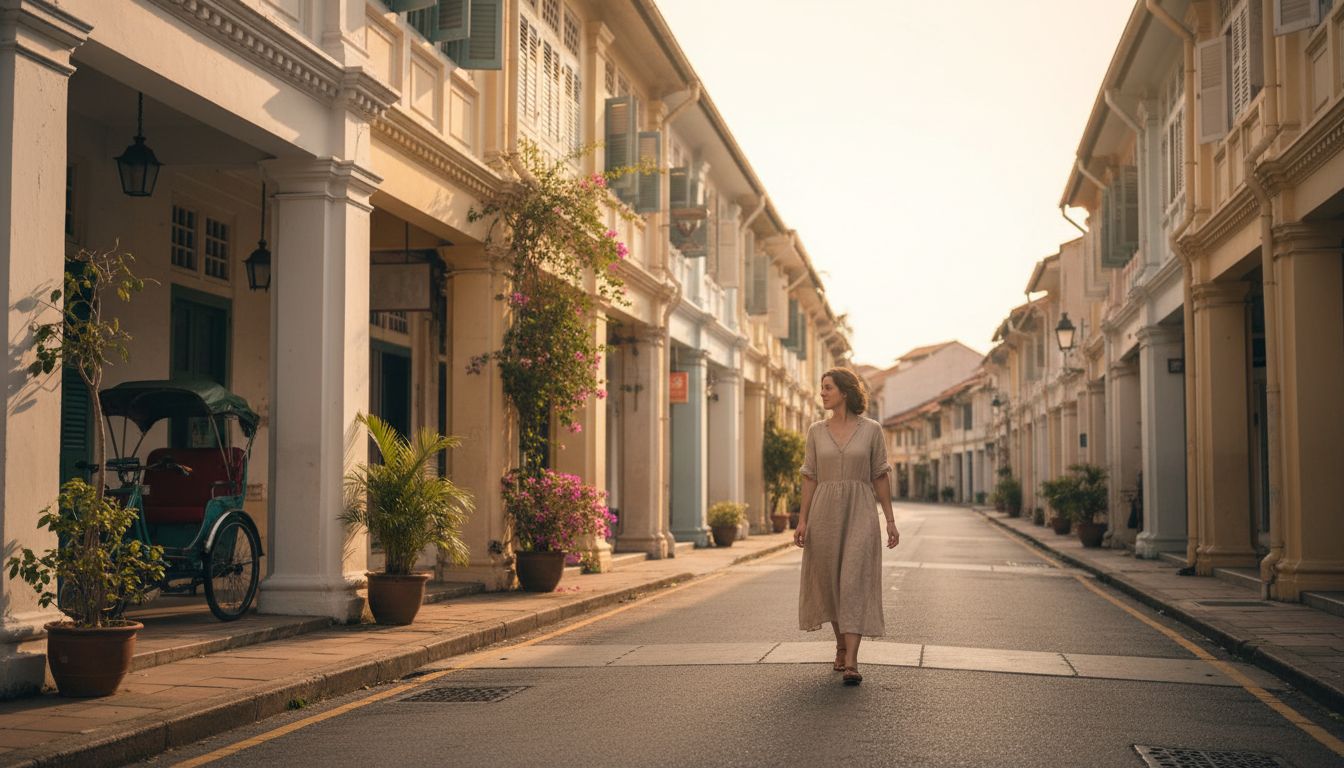
The UNESCO heritage coreOur default pick, and the one thing Penang has that nowhere else in Malaysia does. A dense heritage city where the food, the coffee, the clinics and the ferry are all a walk away and a car is genuinely optional.
The catch: Conservation rules mean the housing stock is old, hot and awkward to modernise, parking barely exists, and the tourist volume in the core streets is a daily fact rather than a seasonal one.
- Cost, relative
- Mid, wide spread by building
- Getting around
- Walk, and buses from Komtar
- Who is there
- Nomads, creatives, long-term residents
- Nights
- Bars, hawker streets, ends earlyish
Pulau Tikus
Just west of the corePick it for George Town's proximity with a normal apartment. The longest-standing foreign community on the island, a genuinely good wet market, Gurney Drive's hawker centre at the bottom of it, and the private hospitals within a short drive.
The catch: Burma Road and Gurney Drive are the island's worst everyday traffic, the walkability is patchy rather than continuous, and you are paying a premium for a location that is still not quite in George Town.
- Cost, relative
- Higher, on newer stock
- Getting around
- Walkable pockets, bus or car beyond
- Who is there
- Long-term expats, retirees, families
- Nights
- Restaurants and Gurney, not late
Tanjung Tokong
North coast, on reclaimed landPick it for a modern condominium with facilities and water in front of it. Seri Tanjung Pinang and Straits Quay are the newest housing on the island and the easiest place here to find a family-sized unit that is not forty years old.
The catch: It is a development rather than a neighbourhood and it behaves like one — nothing within a walk that you did not drive to, one congested road in and out, and a sea frontage that is itself reclaimed land.
- Cost, relative
- Highest of the five
- Getting around
- Car, effectively always
- Who is there
- Families, MM2H holders, marina crowd
- Nights
- Straits Quay, and quiet after
Batu Ferringhi
The north beach stripPick it if the sea is the reason you are here. The island's beach strip, quiet outside the resort frontage, and the cheapest way to wake up looking at water anywhere in this comparison.
The catch: One road connects it to everything and it queues badly, so George Town is a real trip rather than a hop. Amenities are thin, the beach is not the best in the region, and the jellyfish season is a genuine constraint.
- Cost, relative
- Low, for what you get
- Getting around
- Car, on one coastal road
- Who is there
- Retirees, resort staff, weekenders
- Nights
- The night market, and little else
Bayan Lepas
South, by the airportPick it if your reason for being here is work or flights. The free industrial zone holds the semiconductor employers that built modern Penang, the airport is on the doorstep, and the LRT under construction terminates here.
The catch: It is an industrial and commuter district, George Town is a genuine drive away, and the LRT that will eventually serve it is also a decade of construction happening around you first.
- Cost, relative
- Lowest of the five
- Getting around
- Car, with the second bridge close
- Who is there
- Engineers, corporate transfers, students
- Nights
- Malls and food courts, local
There is no rail here, and the first line is a 2030s answer
Penang has no urban rail at all. Rapid Penang's buses and Grab are the whole of public transport, and outside George Town most people drive. That is the single largest practical difference between this island and Kuala Lumpur, and it is the one most comparisons skip.
The fix exists and it is real, but it is slow. Construction on the LRT Mutiara Line began in January 2026, running from Komtar through Bayan Lepas to the airport and across to Penang Sentral on the mainland, and the project is required to be completed by December 2031. Anyone weighing Penang on the strength of that line should be clear that it is a decision about the 2030s, and that the intervening years are the construction.
So the honest planning assumption for the rest of this decade is buses, Grab, a scooter or a car — and George Town as the one part of the island where none of that is required. Two road bridges carry everything to the mainland, the 13.5 km original and the 24 km second crossing, and the ferry has carried passengers, bicycles and motorcycles only since the car service ended.
The island is small, and that is the actual argument for it
Penang works because the whole of it is within about an hour of the rest of it. George Town is a real city with a heritage core dense enough to live in on foot — a UNESCO World Heritage Site since 2008, inscribed with Melaka, and unusual among such places in still being an ordinary working town rather than a museum with residents.
That scale is what people are actually choosing when they pick this over Kuala Lumpur. The hospitals, the airport, the beach and the old city are all inside a short drive of each other, where the equivalent set in the capital is spread across a metropolitan area that takes an hour to cross in one direction.
The trade is depth. International schools, specialist medicine, corporate employers and long-haul flights all exist here at a fraction of the capital's range, and the honest version is that Penang is the better place to live and Kuala Lumpur is the better place to need something.
What is genuinely bad here
The haze, and it is live rather than historical. On 25 August 2026 Penang recorded three stations in the Unhealthy band — Minden at 154, Balik Pulau at 152 and Seberang Perai at 136 — during an episode driven by regional burning that had already run for weeks and prompted the state health exco to advise face masks.
The state has a published trigger worth knowing if you have children here: schools call off outdoor activities once the index passes 100 and close above 200. That is a clearer rule than most places publish, and it is also a reminder that this is a recurring feature of dry spells rather than a freak year. The Department of Environment posts hourly readings from stations across the state, so the month you are actually asking about has a public answer.
After that it is the driving, covered above, and the bridges — two crossings carry every vehicle between the island and the mainland, and an incident on either is felt by everyone. Then the heat, which never lets up because there is no dry season here to escape into.
Healthcare here, specifically
Penang is the centre of Malaysia's medical-tourism industry rather than a beneficiary of it — the state generates roughly forty per cent of the country's healthcare-travel volume, and the patients arriving from Indonesia across the strait are the reason the private hospitals here are the size they are.
Island Hospital, Gleneagles Penang and Penang Adventist are the three most foreigners end up using, all within reach of George Town and Pulau Tikus, and Gleneagles Penang and Penang Adventist both hold international accreditation. As on our Kuala Lumpur page, that is worth checking against Joint Commission International's own directory rather than taking from any website including this one: accreditations lapse and get renewed.
What Penang does not have is the capital's specialist tail. Routine and mid-complexity care is excellent here and cheaper than KL; the rare sub-specialty is still a flight or a drive south. That is the shape of the trade, and it is the one thing a retiree weighing the two cities should price properly.
How people actually find a place, and what the terms mean
iProperty, PropertyGuru, Mudah and Speedhome carry the listings and agents carry the rest, exactly as on the mainland. Penang adds one wrinkle: the heritage core is shophouses under conservation rules, and what has been done to the inside of one — air conditioning, wiring, damp, fibre — varies enormously between two buildings on the same street. Viewing in person matters more here than almost anywhere else on this site.
The entry cost is Malaysia's standard formula and it has a name: two plus one plus a half. Two months of security deposit, one month of rent in advance and half a month as a utility deposit, so roughly three and a half months of rent before you hold a key.
None of that is capped. Malaysia has no Residential Tenancy Act in force, so the tenancy agreement and ordinary contract law are the whole of your protection, and the clause governing how and when the deposit comes back is the one to read twice.
The visa is the country's, not the city's
Living in Penang is not a different permission from living anywhere else in Malaysia. The two routes are the DE Rantau nomad pass, a twelve-month professional route with an income test, and MM2H, which applies no income test and instead asks for a fixed deposit plus a compulsory property purchase.
The figures, the tiers and the government pages behind them are on the Malaysia guide and the visa records linked from this page. The Penang detail worth knowing is social rather than legal: this island has the largest and longest-established MM2H community in the country, which is why the programme is easier to ask real questions about here than anywhere else — and also why local agents selling it are everywhere.
Where the rent figure comes from, and what is still missing
The Tanjung Tokong rent comes from 12 one-bedroom listings on PropertyGuru, a Malaysian property portal, read one at a time in September 2026. Tanjung Tokong here means the towers along Jalan Tanjong Tokong and on the Seri Tanjung Pinang reclaimed land, plus The Meg on Andaman Island to the south-east, which the portal also files under Tanjung Tokong. For each listing we noted the building, size, furnishing, asking price in ringgit and the date it was last posted. We read fifteen, no more than two from any one building, and dropped three: two studios listed as one-bedrooms, and one unit that two agents were advertising.
These are portal asking prices: what a foreigner searching the listings sees, not the price a Malaysian tenant would negotiate for the same unit, and not what anyone pays after negotiating. All twelve are furnished, they sit in eight different buildings, and ten ask between RM 2,400 and RM 4,500 a month. Five of the twelve are listed by the same agency.
The figure covers the high-rise side of the island only. George Town's heritage core is shophouses under conservation rules, and a one-bedroom there is a different kind of home from a condominium unit, so one figure cannot describe both. We tried George Town first: PropertyGuru held three one-bedroom listings in the heritage core, all of them houses or shophouses, so it is not sourced.
We tried Pulau Tikus next and could not source it either. On 30 September 2026 a PropertyGuru search for Pulau Tikus found four one-bedroom rentals in three buildings, and one of Mudah's 177 apartment and condo rentals there was a one-bedroom. Batu Ferringhi and Bayan Lepas are not sourced yet, and the neighbourhood cost lines on this page are still relative judgements.
PropertyGuru refuses a plain automated request but reads normally in a browser, which is how these were read. EdgeProp and Mudah read the same way and were not needed for Tanjung Tokong, so this figure rests on one portal. The one strong institutional read of Malaysian rents, the Khazanah Research Institute working through NAPIC's 2024 data, covers Kuala Lumpur only.
Coworking is still blank. Penang has a real market and figures for it circulate freely — round-ups quote anywhere from RM 288 to RM 499 a month — but every one of those traces back to a listicle rather than to the company charging the price. Checked on 26 August 2026: one named operator's own pricing page sells courses and no desks, another's Penang location page carries no rate at all, and two of the operators in those round-ups do not resolve. Kuala Lumpur's page has a coworking figure because the operator published it themselves, and that is the bar.
If you rent in Tanjung Tokong and our figure is wrong for your building, or you can tell us what a desk costs, the box under the cost table is where to tell us.
What a month costs
1 unsourcedPortal asking prices from 12 one-bedroom condo and serviced-residence listings in Tanjung Tokong, read one by one in September 2026 — the price a foreigner searching the portal sees, not the price a Malaysian tenant would negotiate for the same unit, and not what anyone ends up paying after negotiating. This is the high-rise side of the island: the twelve are spread across eight buildings, no more than two from any one, and run from 567 to 1,137 sq ft. All twelve are furnished and ten ask between RM 2,400 and RM 4,500. None says how utilities are billed, so ask. George Town's heritage shophouses are a different market that one figure cannot cover, and they are not sourced. Pulau Tikus could not be sourced either: on 30 September 2026 a PropertyGuru search for it found four one-bedroom rentals in three buildings. The other districts are not sourced yet.
Penang has a real coworking market and none of it publishes a monthly rate we could reach. Figures circulate widely in round-ups — RM 288 to RM 499 a month depending on which listicle you read — but every one traces back to an aggregator quoting an operator rather than to the operator. Checked 2026-08-26: Scoopoint's own pricing page sells courses and no desks, Common Ground's Penang location page carries no rate at all, and two of the operators named in those round-ups do not resolve. A second-hand price is not a source, which is the same bar that let Kuala Lumpur's row publish and keeps this one blank.
1 of these lines has no figure yet.
That is deliberate. We publish a cost line when we have a source we would stand behind and a date we checked it, and leave it blank when we don't — rather than averaging numbers we never verified, which is what the figure you'll find elsewhere usually is. If you live in Penang, this gap is where a correction is worth the most.
Live in Penang? Tell us what you actually pay.
One field is enough. No account, no email — we're collecting figures, not reviews, and a real number from one resident beats an average scraped from nobody.
Practical
Rapid Penang buses and Grab, and that is the whole public network — there is no urban rail on the island. Two road bridges connect it to the mainland, the 13.5 km Penang Bridge and the 24 km second crossing, and the ferry from George Town to Butterworth now carries only passengers, bicycles and motorcycles since the car service was withdrawn.
Among the easier places in the region on this count, and consistent across the areas on this page. The usual island caveats apply instead of urban ones: scooters on narrow heritage streets, and a coast where the swimming is not always as calm as it looks.
Malaysian Ringgit, about RM 4.05 to the dollar on 25 August 2026. Cards and DuitNow QR work everywhere the mainland does, but the hawker stalls George Town is famous for are still substantially cash. A ringgit bank account needs a valid pass rather than a length of stay.
Fibre from TIME, Unifi and Maxis reaches the condominium stock and most of George Town, and Ookla put Malaysia's median fixed broadband at 169.89 Mbps down and 66.10 Mbps up with 8 ms latency in April 2026. Heritage shophouses are the exception worth asking about — what is wired into a conserved building is a building-by-building answer.
Common questions
Which part of Penang should I live in?
George Town for the only genuinely walkable life on the island — the UNESCO heritage core, the food, and no car needed — at the cost of old housing stock and constant tourists. Pulau Tikus is the established foreign-resident pick just west of it, close to the hospitals and Gurney Drive, with the island's worst traffic. Tanjung Tokong has the newest towers and sea views and requires driving for everything. Batu Ferringhi puts you on the beach and a long single road from town. Bayan Lepas is where the semiconductor employers, the airport and the future LRT terminus are, and it is the cheapest of the five.
Do you need a car in Penang?
Everywhere except George Town, yes. There is no urban rail on the island at all — Rapid Penang buses and Grab are the entire public network — and the LRT Mutiara Line only began construction in January 2026 with a December 2031 completion requirement. George Town's heritage core is dense enough to live in on foot and is the one part of Penang where people genuinely do not own a vehicle. In Tanjung Tokong, Batu Ferringhi and Bayan Lepas a car or a scooter is not optional.
Is Penang or Kuala Lumpur better for living long term?
Penang is the better place to live and Kuala Lumpur is the better place to need something. Penang gives you a walkable heritage city, the country's best food, lower rents than the capital, the largest MM2H community and forty per cent of Malaysia's medical tourism within a short drive. Kuala Lumpur gives you the specialist medical tail Penang refers into, international schools in far greater number, long-haul flights, the corporate and embassy base, and an actual rail network. Retirees and solo remote workers mostly choose Penang; families with school-age children and anyone whose work involves Malaysian institutions mostly choose KL.
How bad is the haze in Penang?
Bad in a dry spell and genuinely variable year to year. On 25 August 2026 three Penang stations sat in the Unhealthy band — Minden at 154, Balik Pulau at 152 and Seberang Perai at 136 — in an episode that had already run for weeks and led the state health exco to advise face masks. Penang publishes a clearer school rule than most places: outdoor activities are called off above an index of 100 and schools close above 200. The Department of Environment posts hourly readings, so you can check the month you are actually asking about rather than taking anyone's word for it.