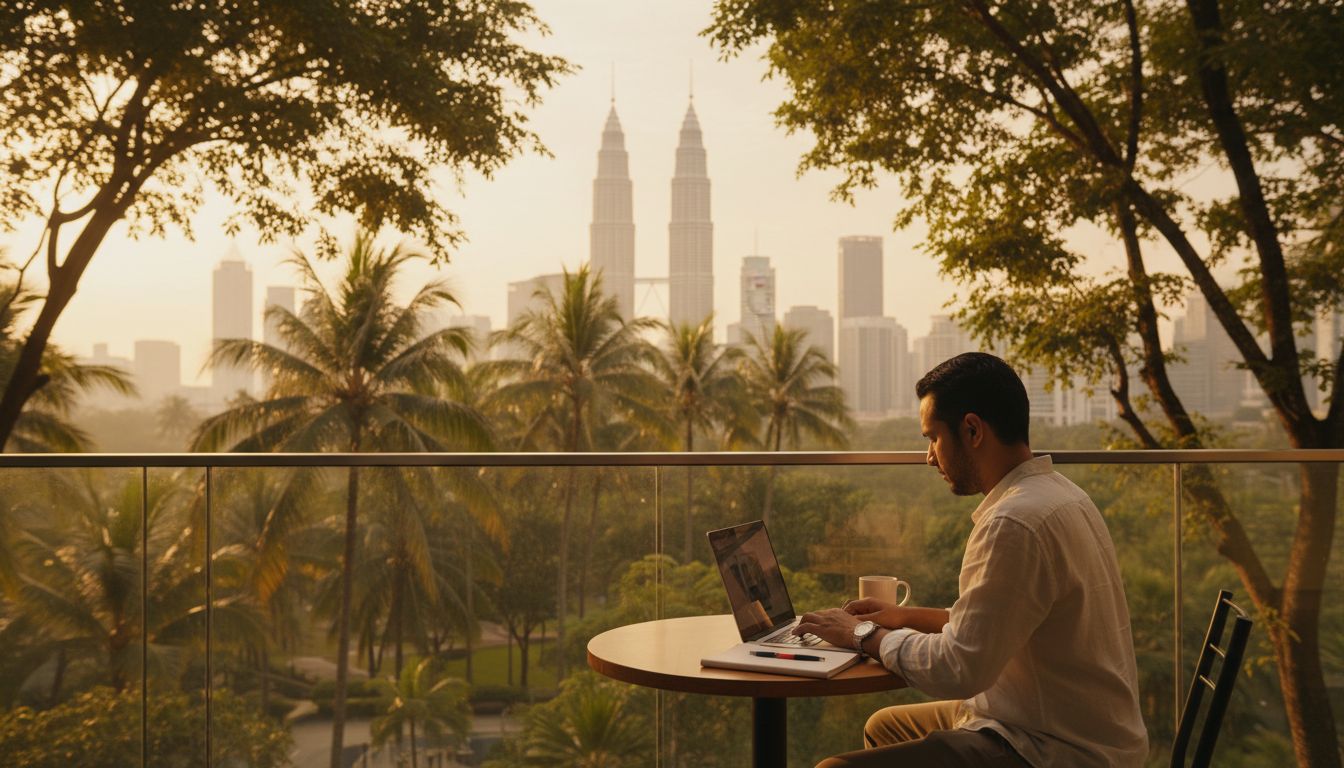
Kuala Lumpur
Malaysia's capital, and the only city in the country with the specialist hospitals, the international schools and the long-haul airport. It has an extensive urban rail network, and most foreigners here still drive.
- Best months
- No dry season
- Hardest months
- Haze, in dry spells
- Getting around
- Six rail lines
- Neighbourhoods
- 5 compared
- Visa
- DE Rantau or MM2H
- Cost data
- 1 row sourced
The Kuala Lumpur guide
Kuala Lumpur is the easiest city in this region to arrive in and the hardest one to describe honestly, because the two things everyone says about it are both half right. It has real urban rail — three LRT lines, two MRT lines, a monorail, commuter trains and an airport express — and it is still a city where most foreigners end up with a car or a standing Grab budget. Which of those two versions you live in is decided almost entirely by the neighbourhood you pick, and that is what this page is for.
Malaysia issues the permission to be here, not Kuala Lumpur — the city does not change what you are allowed to do. Malaysia visa programmes →
Which neighbourhood
5 areasKLCC
Around the towersOur default for a first move. The one part of the city where the offices, the hospitals, the park, the trains and the airport bus are all inside a walk, which is exactly what you want before you know the place.
The catch: You pay the most and you get the least of the city — a high-rise district built for people passing through, where the pavements outside the core are an afterthought and the tourist traffic never stops.
- Cost, relative
- Highest of the five
- Rail access
- LRT and MRT, both on the doorstep
- Who is there
- Corporate expats, short stays, Gulf visitors
- Nights
- Hotel bars and the Changkat strip nearby
Bukit Bintang
The strip, next doorPick it to be central without KLCC's rent. Two stations, the monorail and the MRT, put the whole city within reach, and the food and bars run from hawker stalls to Changkat within one walk.
The catch: It is a tourist district first and a place to live second. Noise runs late on the bar streets, the pavements are crowded at every hour, and the condo stock is older than the rent suggests.
- Cost, relative
- Mid, cheapest central option
- Rail access
- Monorail and MRT, both in the district
- Who is there
- Younger arrivals, nomads, tourists
- Nights
- The city's busiest, and constant
Bangsar
Southwest, off Jalan MaarofPick it for a neighbourhood rather than a development. Bangsar has actual streets, independent restaurants, the long-term foreign community and Pantai Hospital, and it is close enough to the centre to not feel like a suburb.
The catch: The LRT station is on the edge rather than in the middle, so the walk from Bangsar Baru is real in this heat, and parking on the main streets is a nightly argument.
- Cost, relative
- High, below KLCC
- Rail access
- LRT station, a walk from the centre of it
- Who is there
- Long-term expats, Malaysian professionals
- Nights
- Bars and restaurants, ends earlier
Mont Kiara
Northwest, on the hillPick it if you have children. The densest cluster of international schools in the country, modern family-sized condos with real facilities, and a large Japanese, Korean and Western community already there.
The catch: No rail at all. The nearest station is Segambut on the KTM Komuter line, ten to fifteen minutes away by car, so daily life here is driving — and the two roads in and out queue badly at school run and rush hour.
- Cost, relative
- High, family-sized units
- Rail access
- None — nearest is a drive
- Who is there
- International-school families, Japanese and Korean expats
- Nights
- Restaurants, not a nightlife area
TTDI
West, on the Kajang linePick it to stop paying the expat premium without giving up the trains. Taman Tun Dr Ismail is a settled Malaysian suburb with its own MRT station, a proper wet market, low-rise streets and the forest park at the end of it.
The catch: It is a suburb and it behaves like one — quiet after nine, thin on anything aimed at foreigners, and far enough west that a night in the centre means the last train or a fare home.
- Cost, relative
- Lowest of the five
- Rail access
- MRT station inside the neighbourhood
- Who is there
- Malaysian families, a few foreigners
- Nights
- Local and early
The rail network is real. It does not go where foreigners live.
Rapid KL runs six rapid-transit lines — the Ampang, Sri Petaling and Kelana Jaya LRTs, the Kajang and Putrajaya MRTs, and the KL Monorail — with KTM Komuter services and the KLIA airport trains layered on top. On paper that is one of the most complete urban rail systems in Southeast Asia, and in the centre it behaves like one.
Then you look at where the network actually reaches. Mont Kiara, the single most popular address for foreign families in the country, has no station: the nearest is Segambut on the commuter line, ten to fifteen minutes away by car. Bangsar has an LRT station sitting at the edge of the neighbourhood rather than in it. KLCC, Bukit Bintang and TTDI are the three areas on this page where you can genuinely live without a vehicle, and two of them are the ones people move out of.
So the honest version is that Kuala Lumpur is a car city with excellent trains rather than a train city, and the neighbourhood decision is where you settle that. Choosing Mont Kiara for the schools and then being surprised by the driving is the most common version of this mistake; choosing TTDI or Bukit Bintang is how people avoid it.
Where people work, and the one price the city publishes
This is the deepest professional market in Malaysia and it is not close. The regional headquarters, the banks, the multinationals and the outsourcing floors are in and around the centre, and Damansara Heights and Mont Kiara carry a second cluster to the west.
Coworking is correspondingly deep, and Kuala Lumpur is the one city on this site where an operator publishes a monthly rate on its own website rather than leaving it to aggregators. Common Ground lists a hot desk at RM 399 a month at the MDEC DE Rantau hub — about USD 99 at the 25 August 2026 rate — which is the discounted rate tied to Malaysia's nomad pass. It is not a market average, and we have published it as what it is: the number a DE Rantau holder pays, and a floor for anyone else pricing the city.
That is also the clearest illustration of what the pass is for. DE Rantau is not just permission to be here — MDEC built a hub network around it, and the discount is the programme made physical. Colony publishes a RM 60 day pass; most other operators quote on enquiry.
What is genuinely bad here
The haze, and this is not a historical note. As this page was written on 26 August 2026, Malaysia's Department of Environment had seventeen monitoring stations nationwide in the Unhealthy band at 8.45am, with Cheras in Kuala Lumpur reading 159 and Batu Muda 152. The episode had already run for weeks, driven by a dry spell and by open burning here and across the strait.
Two things follow from that. The first is that anyone with a respiratory condition should treat air quality in this city as a live variable rather than a footnote — an air purifier is standard equipment in a Kuala Lumpur condo for a reason. The second is that you can check it yourself before you commit: the DOE publishes hourly readings from sixty-eight stations on its public portal, so the question of how bad this month is has a public answer that does not require trusting us.
After the haze it is the heat and the humidity, which never let up because there is no dry season to escape into, and then the car dependence covered above. None of it is dramatic. It is the accumulation people cite when they leave.
Healthcare here, specifically
This is the strongest argument for Kuala Lumpur over anywhere else in Malaysia, and it is the argument that outlasts the others. The private hospitals people move here for are all in this city or on its edge — Prince Court near KLCC, Gleneagles on Jalan Ampang, Pantai in Bangsar, and Sunway Medical Centre just over the Selangor line in Bandar Sunway.
Malaysia's country guide makes the regional case: this is a country people fly into for treatment rather than out of, which changes what a serious diagnosis costs you in disruption as well as money. Kuala Lumpur is where that is concentrated. Penang has real private hospitals, Johor Bahru has some, and the specialist bench in both is a fraction of this one's.
International accreditation is the thing worth checking yourself rather than taking from a website, ours included: accreditations lapse and get renewed, and Joint Commission International publishes its own directory of accredited organisations. What does not change is that these are private hospitals which bill upfront, and the public system is not built around foreigners.
How people actually find a place, and what the terms mean
iProperty, PropertyGuru, Mudah and Speedhome carry the listings, agents carry the rest, and in the condo towers a large share of units are let by individual owners through building groups rather than through a portal at all. Viewing in person is worth more here than in most of the region, because the gap between two blocks on the same street can be twenty years of building age.
The entry cost is the part that catches people out, and Malaysia's version has a name. The market formula is two plus one plus a half: two months of security deposit, one month of rent in advance, and half a month as a utility deposit — roughly three and a half months of rent handed over before you hold a key.
There is no Residential Tenancy Act in force in Malaysia, so none of that is capped or governed by statute. The tenancy agreement and ordinary contract law are the whole of your protection, which makes the return conditions on the deposit the clause worth reading twice rather than the rent.
The visa is the country's, not the city's
Living in Kuala Lumpur is not a different permission from living anywhere else in Malaysia. Two routes reach it and they are nothing alike: the DE Rantau nomad pass, a twelve-month professional route with an income test, and MM2H, which applies no income test at all and instead asks for a fixed deposit plus a compulsory property purchase.
The figures, the tiers and the government pages they were checked against are on the Malaysia guide and the visa records linked from this page. The one genuinely Kuala Lumpur detail: the immigration headquarters and every embassy in the country are here, and so is the DE Rantau hub network, so anything that turns out to need a person rather than a portal is easier from this city than from anywhere else in Malaysia.
What we have sourced, and what is still blank
The coworking row on this page is sourced to the operator's own site and dated. That makes Kuala Lumpur the second city in this dataset with a real cost figure behind it, and the first where the figure came from the company charging it rather than from a listings portal.
Rent is still blank. Every Malaysian portal — iProperty, PropertyGuru, Speedhome, Mudah — returns a 403 to a plain automated request, checked on 26 August 2026. PropertyGuru reads normally in a browser, which is how our Penang rent figure was collected, but we have not read Kuala Lumpur listings that way yet. Malaysia does publish an official rental series through NAPIC, and the Khazanah Research Institute worked through it in December 2025: all 420 rental projects in the city, an affordable band of RM 700 to 1,100 a month, and only 45 of those 420 within reach of someone on the RM 3,687 median salary.
That is a genuinely good source and it answers a different question from the one this row asks. It measures what a Malaysian on a median wage can afford, not what a foreigner pays in KLCC or Mont Kiara, and quoting it as a rent figure for this audience would be citing a source for a claim it never made. So the row stays blank and says so. It publishes at five dated resident submissions naming the neighbourhood and whether the unit is furnished — the box under the table is where those go.
What a month costs
1 unsourcedEvery Malaysian rental portal refuses a plain automated request — iProperty, PropertyGuru, Speedhome and Mudah all return HTTP 403 to a cold request, checked 2026-08-26. PropertyGuru reads normally in a browser, which is how the Penang rent row was collected; Kuala Lumpur listings have not been read that way yet. What Malaysia does have, and its neighbours do not, is an official rental series that a public institute has already worked through: the Khazanah Research Institute, using NAPIC 2024 data and published 12 December 2025, examined all 420 apartment, condominium and serviced-apartment projects listed for rent in Kuala Lumpur and put the AFFORDABLE band at RM 700–1,100 a month — floor RM 700 at Sentul Park, cheapest serviced apartment RM 1,000 at Kiara Designer Suite. That figure is real and government-derived, and it measures what a Malaysian on the RM 3,687 median salary can reach: only 45 of the 420 projects qualified. It is not what a foreigner pays in KLCC, Bangsar or Mont Kiara, so putting it in this row would be citing a source for a claim it does not make. Publishing at five dated resident submissions naming the neighbourhood and whether the unit is furnished.
Published by the operator on its own locations page rather than by an aggregator, which is the wall Bangkok's and Manila's coworking rows are still stuck behind. It is a specific rate, not a market average: the hub is MDEC's DE Rantau partner site and RM 399 is the discounted rate attached to that programme, so it is what a DE Rantau pass holder actually pays and a floor for everyone else. Common Ground's other Kuala Lumpur sites — KLCC, Damansara Heights and Mont Kiara — publish no monthly rate at all, and Colony publishes a RM 60 day pass and no monthly figure.
1 of these lines has no figure yet.
That is deliberate. We publish a cost line when we have a source we would stand behind and a date we checked it, and leave it blank when we don't — rather than averaging numbers we never verified, which is what the figure you'll find elsewhere usually is. If you live in Kuala Lumpur, this gap is where a correction is worth the most.
Live in Kuala Lumpur? Tell us what you actually pay.
One field is enough. No account, no email — we're collecting figures, not reviews, and a real number from one resident beats an average scraped from nobody.
Practical
Rapid KL runs three LRT lines, two MRT lines and the monorail, with KTM Komuter and the KLIA airport trains on top. Coverage is good across the centre and the southern and western suburbs, and absent in some of the places foreigners most want to live. Grab is the default everywhere else and surges in the afternoon storms.
Comfortable by regional standards and consistent across the areas on this page — a smaller gap between adjacent neighbourhoods than Manila has. Snatch theft from motorbikes is the crime residents actually warn about, which argues for walking on the inside of the pavement and not holding a phone at the kerb.
Malaysian Ringgit, about RM 4.05 to the dollar on 25 August 2026. Card and DuitNow QR acceptance is close to universal. A ringgit bank account needs a valid pass rather than a length of stay — Malaysia gates it on status, not time, which is the opposite of the Philippines.
Fibre from TIME, Unifi and Maxis reaches the condo stock across every area here, and Ookla put Malaysia's median fixed broadband at 169.89 Mbps down and 66.10 Mbps up with 8 ms latency in April 2026. Ask which providers are already wired into the specific building — in older blocks that is the whole answer.
Common questions
Which area of Kuala Lumpur should I live in?
KLCC for a first move — everything walkable, everything at the highest price, and both LRT and MRT on the doorstep. Bukit Bintang next door is the cheapest way to live centrally and the loudest, with the monorail and the MRT in the district. Bangsar is the low-rise, leafy option long-term residents stay in, with the LRT station at its edge rather than its centre. Mont Kiara is where international-school families go and it has no rail at all. TTDI is the value pick and the only one of the five outside the centre with an MRT station inside the neighbourhood.
Do you need a car in Kuala Lumpur?
It depends entirely on the neighbourhood, which is why the choice matters more here than the rent does. In KLCC, Bukit Bintang and TTDI you can live without one: Rapid KL's three LRT lines, two MRT lines and the monorail cover those areas properly. In Mont Kiara you cannot — there is no station, and the nearest is Segambut on the commuter line, ten to fifteen minutes away by car. Bangsar sits in between, with a station at the edge of a neighbourhood that is a hot walk across. Most foreigners here end up with a car or a standing Grab budget, and most of them did not have to.
What deposit do landlords ask for in Kuala Lumpur?
The market formula is two plus one plus a half — two months of security deposit, one month of rent in advance and half a month as a utility deposit, so roughly three and a half months of rent before you get a key. None of it is capped: Malaysia has no Residential Tenancy Act in force, so the tenancy agreement and ordinary contract law govern the amount, the conditions and the refund. Read the deposit-return clause more carefully than the rent — that is where the money is actually at risk.
How bad is the haze in Kuala Lumpur?
Variable year to year and genuinely bad in a dry spell. On 26 August 2026 Malaysia's Department of Environment had seventeen stations nationwide in the Unhealthy band, with Cheras in Kuala Lumpur at 159 and Batu Muda at 152, in an episode that had already run for weeks. It is driven by dry weather and by open burning in the region, so it varies enormously between years rather than following a season you can plan around. The useful thing is that you do not have to take anyone's word for it: the DOE publishes hourly readings from sixty-eight stations on a public portal, so you can check the month you are actually asking about.