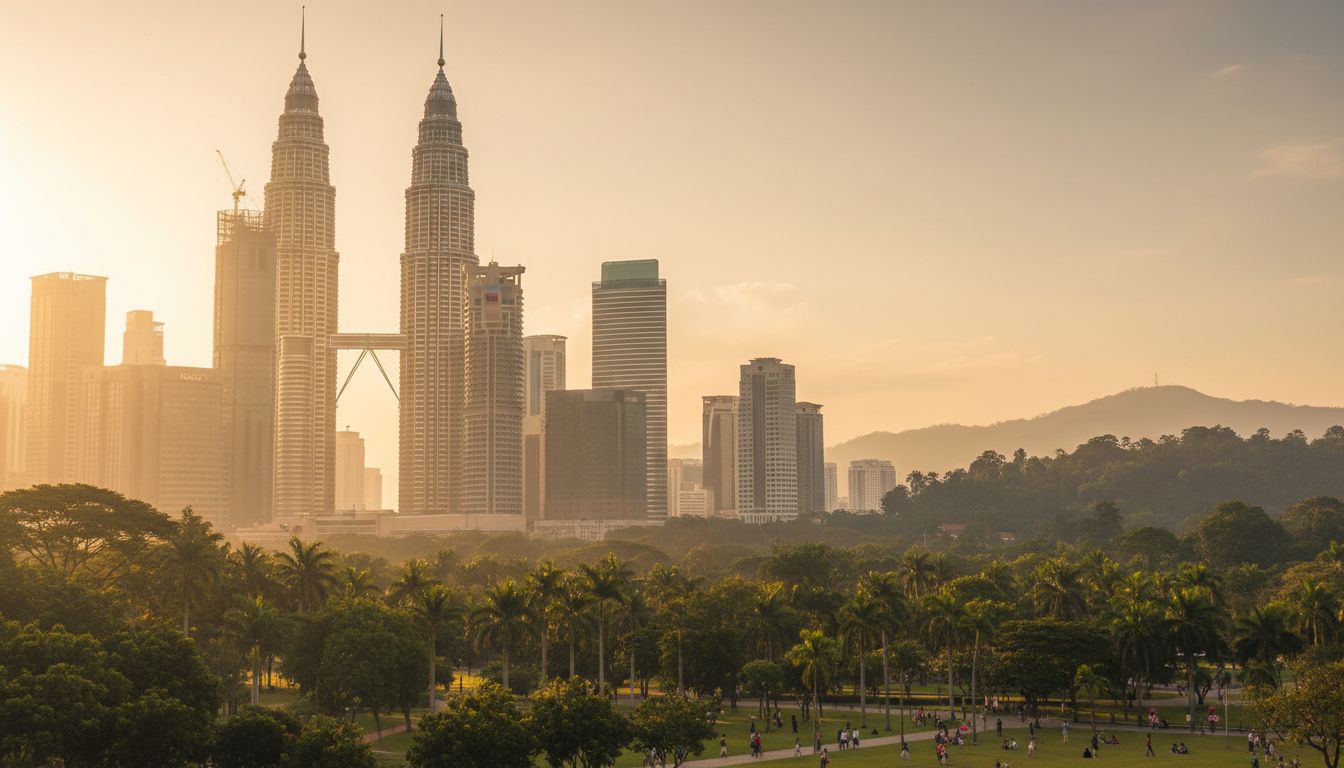
Living in Malaysia long-term
Malaysia is the easiest country in this region to land in and the hardest to read the marketing on. English works everywhere, the private hospitals are among the best in Asia and the food is a genuine reason to live somewhere. But the long-stay programme it is famous for is not a retirement visa in the sense people assume — MM2H applies no income test and instead asks for a deposit plus a compulsory house purchase, which makes it the highest capital bar of any route we track. Decide where you would live first; that choice survives whichever visa you end up on.
Two routes with nothing in common. The DE Rantau pass is a nomad visa with an income test, aimed at digital professionals. MM2H is residence by investment: no income test at all, a fixed deposit and a compulsory property purchase, the highest capital bar of any route we hold. Neither is decided by which city you live in, though MM2H's cheapest tier exists only in Johor.
Which Malaysia visa can you get? →Where to base yourself in Malaysia
These are not interchangeable. Costs are a monthly total for one person living normally, not a survival floor.
Kuala Lumpur
Everything is here, and so is the traffic.
Penang
The island people actually retire to. Also the food.
Johor Bahru
Malaysian prices, Singapore across the bridge.
Side by side, on the things that actually differ:
| Axis | Kuala Lumpur | Penang | Johor Bahru |
|---|---|---|---|
| Cost, relative | Highest in Malaysia | Below KL, mostly on rent | Lowest of the three |
| Getting around | Rail exists, city built for cars | Car or scooter, no rail | Car, and the causeway |
| Who is there | Corporate expats, every nationality | Retirees, MM2H holders, food tourists | Singapore commuters, SEZ buyers |
| International access | KLIA, direct almost everywhere | Regional airport, KL for long-haul | Changi, across the border |
| The catch | The rail map flatters it. The lines do not reach most residential areas, so daily life is a car or a standing Grab budget, and rent sits clearly above anywhere else in the country. | No rail at all, and the island's traffic has outgrown its roads — the bridges are a genuine chokepoint. International schools and specialist medicine exist but at a fraction of KL's depth, which is the trade families feel first. | The causeway is the life. Hundreds of thousands cross it on a busy day and a bad morning is measured in hours, not minutes. It is also a commuter belt rather than a destination — a lot of what people go out for is on the other side. |
Cost is relative on purpose. Sourced monthly figures live on each city page, dated and attributed — and left blank where we have not sourced one rather than estimated.
How Malaysia compares in Asia
Ranked against every country in the region we hold a record for. Countries that publish no figure are excluded from the count rather than treated as zero.
- Income required
- $2000 a month — 2nd lowest of the 7 Asian countries that publish an income figure.
- Length of stay
- 24 months — joint longest of the 7 Asian routes that publish a length.
The monsoon only really hits one coast, and it is not the one you would live on
Malaysia runs two monsoons and they behave completely differently. The northeast monsoon, November to March, is the serious one: it lands on the east coast of the peninsula — Kelantan, Terengganu, Pahang — where the sea turns rough and the resort islands like Perhentian and Redang simply close for the season.
The southwest monsoon, roughly May to September, is the mild one, and the west coast mostly experiences it as short afternoon thunderstorms. Which matters because every city worth basing yourself in here — Kuala Lumpur, Penang, Johor Bahru, Melaka — is on the west coast. The monsoon that dominates Malaysia's weather reputation is largely a holiday-planning problem rather than a living-here problem.
What does reach the west coast is haze. Regional forest and peatland fires push smoke over the peninsula and Borneo in dry spells, badly in some years and barely in others. It is the one genuinely unpredictable part of the climate here, and the reason anyone with a respiratory condition should treat air quality as a live question rather than a footnote.
Banking turns on which pass you hold, not on how long you have been here
This catches people who have moved from elsewhere in the region. The Philippines gates a bank account on time — 59 days, then you can get the ID that unlocks it. Malaysia gates it on status: you need a valid pass, and an employment pass, student pass, dependent pass or MM2H all count. A tourist stamp does not, and no amount of waiting turns one into the other.
Beyond the pass, expect to prove a Malaysian address with a tenancy agreement or a utility bill in your name, and to be asked for an introduction letter from an employer, university or embassy. It is done in person at a branch — a first account for a new foreign customer is not something you finish online — and banks have grown stricter about it rather than looser.
The practical consequence is an ordering problem. The pass comes before the account, the address comes before the account, and the landlord wants paying before any of it. Plan the first stretch on foreign cards and transfers rather than assuming a local account arrives early.
Healthcare is the strongest thing Malaysia has, and it is why the sums work
Malaysia runs a genuine medical-tourism industry rather than merely tolerable local care. Private hospitals in Kuala Lumpur — Prince Court, Gleneagles and their peers — operate to international standards with English-speaking specialists, and people fly in from across the region for treatment rather than out of the country for it.
That changes the arithmetic of living here in a way a cost table does not capture. In most of Southeast Asia the honest advice on a serious diagnosis is that the complex work happens somewhere else, and your policy needs an evacuation limit that can carry it. In Malaysia the treatment is far more likely to happen where you already live.
What you still need is cover. The private system is the one foreigners use, it is not free, and the public system is not built around you. Penang and Johor Bahru both have real private hospitals; the deepest specialist bench is in KL, which is one of the quieter arguments for the capital.
Who Malaysia is a bad fit for
Anyone whose plan depends on a cheap, low-commitment long-stay visa. MM2H asks for a fixed deposit and a compulsory property purchase you cannot sell for ten years, and the DE Rantau nomad pass is a twelve-month professional route with an income test, not a way to settle. Neighbouring countries ask for less capital.
Anyone who wants a walkable city. Kuala Lumpur has rail and is still built around cars; Penang and Johor Bahru have none. If not owning a vehicle is part of why you are leaving home, this is a harder country to do that in than Thailand or Vietnam.
Anyone who wants nightlife at the centre of their life. Malaysia is a Muslim-majority country, alcohol is taxed heavily and is a different proposition socially than in Bangkok or Saigon. Plenty of people consider that an improvement — but it is a real difference and it is rarely stated plainly.
What a year costs, and the tax rule that moves the answer
The spread across these three is real but narrower than the region's: Johor Bahru is the cheapest, Penang sits below Kuala Lumpur mostly on rent, and KL is the most expensive place in the country. All three are materially below Singapore, which is the entire economic logic of Johor Bahru.
We publish only the Malaysian cost figures we have sourced ourselves, and there are two: a coworking desk rate in Kuala Lumpur, taken from the operator's own site, and one-bedroom rent in Penang's Tanjung Tokong, read from portal listings. Each is dated on its city page. The rest stay blank, because an estimate typed into a page is indistinguishable from a researched one to whoever reads it.
The rule that moves the number more than rent does is tax. Malaysia taxes territorially and generally exempts foreign-sourced income received by individuals, with residency attaching at 182 days. That is a feature of Malaysian tax law rather than a perk of any visa — MM2H marketing presents it as a programme benefit and it is not one. The exemption also has a moving expiry: previously 31 December 2026, extended by Budget 2026 to 31 December 2036. Confirm the current position with LHDN before building a plan on it.
Before you go
Malaysia's private hospitals are the reason a lot of people choose this country over its neighbours, and they are the system foreigners actually use. Cover is what makes that access real rather than theoretical.
Compare long-stay health coverCommon questions
Where should I live in Malaysia as a foreigner?
Kuala Lumpur for the full set — the specialist hospitals, the international schools, the long-haul airport and the deepest professional scene — at the highest cost in the country and a life built around a car despite the rail. Penang for a smaller, cheaper island life with the strongest retiree and MM2H community and the best food in the region, at the cost of no rail and much thinner schooling and specialist medicine. Johor Bahru to arbitrage the Singapore border, which is also where MM2H's cheapest tier sits.
Is Malaysia cheaper than Thailand for expats?
Broadly comparable rather than dramatically cheaper, and the difference that matters is not the rent. Malaysia's advantages are structural: English works everywhere, the private hospitals are among Asia's best so serious treatment happens where you live rather than after an evacuation, and foreign-sourced individual income is generally exempt from tax. Thailand's advantage is that its long-stay routes ask for far less capital — the Thai retirement visa is a deposit in the tens of thousands, where Malaysia's MM2H starts at a USD 150,000 deposit plus a compulsory property purchase.
Can I open a Malaysian bank account as a foreigner?
Yes, but only with a valid pass — an employment pass, student pass, dependent pass or MM2H. Unlike the Philippines, where the gate is time, Malaysia's gate is status: a tourist stamp will not get you a ringgit account no matter how long you stay. You will also need proof of a Malaysian address such as a tenancy agreement or a utility bill in your name, often an introduction letter, and a visit to a branch in person.
When is the best time of year to be in Malaysia?
For the west coast, where all the cities worth basing yourself in sit, the year is fairly even — the southwest monsoon from May to September arrives mostly as afternoon thunderstorms. The northeast monsoon from November to March is the severe one and it hits the east coast, closing island resorts like Perhentian and Redang for the season. The genuinely unpredictable factor is haze from regional forest fires, which reaches the west coast and Borneo in dry spells and varies a lot year to year.
The regional comparison on this page is read from our verified dataset, whose records carry the date each was last checked against its government source. How we check them: our method.