Johor Bahru
Malaysian costs with Singapore's airport, salaries and specialists across a one-kilometre causeway. The border is the defining daily fact, and in January 2027 a rail link changes what it costs you.
- Best months
- No dry season
- Hardest months
- Haze, in dry spells
- Getting around
- Car — RTS opens Jan 2027
- Neighbourhoods
- 5 compared
- Visa
- MM2H's cheapest tier
- Cost data
- Not yet sourced
The Johor Bahru guide
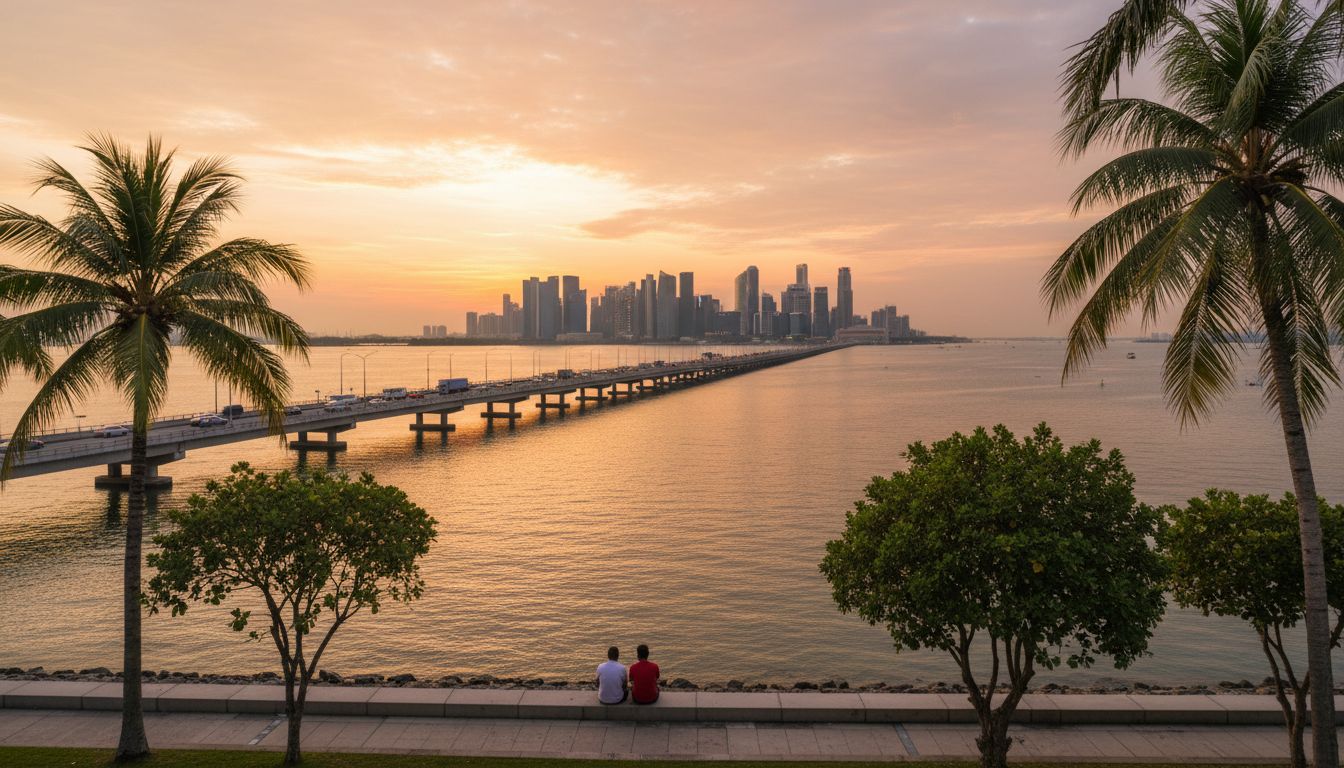
Johor Bahru is the only city in this vertical whose defining fact is somewhere else. It sits a kilometre from Singapore across a causeway that carries three hundred thousand people or more on an ordinary day, and almost everything people like and dislike about living here follows from that — the rents that are a fraction of Singapore's, the salaries that are not, and the mornings measured in hours. In January 2027 a rail link opens across the same strait, and it is the single largest change coming to any city on this site.
Malaysia issues the permission to be here, not Johor Bahru — the city does not change what you are allowed to do. Malaysia visa programmes →
Which part of Johor Bahru
5 areasCity centre
At the checkpointOur pick if the border is why you are here. JB Sentral, the causeway and the RTS terminus at Bukit Chagar are all inside a walk, which makes this the one part of the city where a daily commute to Singapore does not start with a car.
The catch: It is a border town centre and it behaves like one — day-trip crowds, heavy traffic funnelling toward the checkpoint, and housing stock that is older and more mixed in quality than the western townships.
- Cost, relative
- Mid, wide spread by building
- To the border
- On foot
- Who is there
- Commuters, shoppers, newer arrivals
- Getting around
- Walkable core, buses, Grab
Danga Bay
Waterfront, west of the centrePick it for a modern high-rise with water in front of it and the centre still close. The waterfront strip has the newest condominium stock in the inner city, a marina and mall complex, and views straight across the strait.
The catch: A lot of it is investment stock rather than homes, so occupancy in some blocks is thin and the promised ground-floor life has not fully arrived. Much of it is also commercial title, which carries higher utility tariffs than a residential unit.
- Cost, relative
- High, for new-build
- To the border
- Short drive, causeway side
- Who is there
- Singaporean owners, investors, some expats
- Getting around
- Car
Mount Austin
Northeast, inlandPick it to live in a Malaysian city rather than a border facility. Mount Austin and the Tebrau corridor have the food, the malls, the international schools and the space, at prices below anything on the water.
The catch: The distance is the whole trade. A daily Singapore commute from here is a serious undertaking, there is no walkability to speak of, and the Tebrau highway at rush hour is its own problem before you reach the queue.
- Cost, relative
- Below the waterfront
- To the border
- 25 to 35 minutes by car
- Who is there
- Malaysian families, school families
- Getting around
- Car, always
Iskandar Puteri
West, the master-planned zonePick it if you have children. This is where the international schools and Gleneagles Medini are, the Second Link rather than the causeway is your crossing, and the whole district was planned rather than accumulated.
The catch: Master-planned means quiet in the way a business park is quiet — very little that was not put there on purpose, long distances between things, and stretches that are still waiting to be filled in.
- Cost, relative
- High, family-sized
- To the border
- Second Link, not the causeway
- Who is there
- School families, corporate transfers
- Getting around
- Car, on wide roads
Forest City
Furthest west, on reclaimed islandsPick it only with your eyes open, and there is one specific reason to: the Special Financial Zone here carries Malaysia's most aggressive tax incentives, and MM2H's cheapest tier by a wide margin requires the property to be in this development.
The catch: It is famous for being empty and the reputation is earned — a large planned development running well behind its population targets, with amenities to match. The financial zone is a real policy with real incentives; whether the town around it fills up is still an open question.
- Cost, relative
- Low for what is built
- To the border
- Second Link, furthest out
- Who is there
- MM2H holders, SFZ businesses, few residents
- Getting around
- Car, and there is little to reach
The causeway is the city, and in January 2027 it changes
Everything about living here routes through a strip of road and rail just over a kilometre long. Somewhere around three hundred thousand people cross the Johor–Singapore causeway on an ordinary day, which makes it one of the busiest land borders anywhere, and a bad morning is measured in hours rather than minutes.
That is about to be partly solved. The RTS Link — four kilometres of rail from Bukit Chagar in the city centre to Woodlands North on Singapore's Thomson-East Coast Line — is on track to open in January 2027, with a design capacity of ten thousand passengers an hour in each direction and roughly forty thousand daily commuters expected at opening. Physical construction is essentially finished; the work remaining is systems and testing.
Two consequences worth being clear about. If you are choosing a neighbourhood now for a Singapore commute later, walking distance to Bukit Chagar is worth more than it looks on a 2026 map. And forty thousand daily journeys is a fraction of three hundred thousand — the rail link takes the pressure off the queue, it does not remove it, and anyone driving will still be driving.
Where the money is coming from, and why it is not ordinary property hype
Malaysia and Singapore signed the Johor–Singapore Special Economic Zone agreement on 7 January 2025 — roughly 3,588 square kilometres of southern Johor, nine flagship areas, eleven target sectors from manufacturing and logistics to financial services and healthcare. Malaysia announced its incentive package the following day.
Inside it sits the Forest City Special Financial Zone, the country's first, pitched at financial institutions, family offices and wealth management. Its published framework includes a 0% rate for qualifying single family office vehicles for up to twenty years, a 5% corporate rate for approved activities, and a 15% personal rate for eligible knowledge workers — all subject to conditions and approvals.
We are naming this because it explains the building, not because we are recommending it. Johor Bahru is being rebuilt around a bilateral policy rather than around organic demand, which is the reason so much housing here is new and the reason a lot of it is empty. Whether the policy delivers the population is the open question a resident is actually betting on.
What is genuinely bad here
The border, on any day you have to use it. There is no version of living in Johor Bahru where the checkpoint is not part of the calculation, and the cost is not the queue itself so much as the way it makes every plan conditional. People who thrive here are the ones who arranged their life to cross rarely or at odd hours; people who commute daily by car describe it the way Manila residents describe traffic.
Then the emptiness. This city has a great deal of new housing built for buyers rather than residents, and whole developments — Forest City is only the most famous — run well below the population they were designed for. It is not dangerous or unpleasant, but a tower where a third of the units are dark is a different thing to live in than the brochure described.
The haze reaches here too, and this is the one metric on which Johor Bahru comes off best of Malaysia's three cities. On 25 August 2026, with thirty stations nationwide in the Unhealthy band and Kuala Lumpur and Penang both among them, the city's own stations sat in the Moderate range — Pasir Gudang at 80 and Larkin Lama at 79 — while inland Johor towns like Segamat and Batu Pahat read 152. Being on the southern tip is worth something.
Healthcare here, specifically
Johor Bahru has real private hospitals — Gleneagles Medini in Iskandar Puteri, KPJ Johor Specialist and Regency Specialist among them — and they cover routine and mid-complexity care comfortably. What this city does not have is Kuala Lumpur's specialist depth or Penang's medical-tourism scale.
What it has instead is unique in this vertical: world-class hospitals about forty minutes away in another country. That is genuinely useful and it is also a trap, because a Singapore admission is billed at Singapore prices and most Malaysian and regional policies do not cover it properly. Check whether your cover includes Singapore before you assume proximity is the same as access.
For anything the local hospitals handle, this is straightforwardly cheaper than the same care across the strait, which is a large part of why Singaporeans come the other way for dentistry and routine procedures. The private system is the one foreigners use here as everywhere in Malaysia, and it bills upfront.
How people actually find a place, and what the terms mean
iProperty, PropertyGuru, Mudah and Speedhome carry the listings and agents carry the rest. Johor Bahru's own wrinkle is title: a large share of the newer waterfront and Medini stock is sold and let as serviced apartments on commercial title rather than residential, which means commercial utility tariffs and commercial assessment rates. Ask which one a unit is on before the rent.
The entry cost is Malaysia's standard formula — two plus one plus a half: two months of security deposit, one month of rent in advance, half a month as a utility deposit. Roughly three and a half months before you hold a key, and none of it capped, because Malaysia has no Residential Tenancy Act in force.
The other local fact worth knowing is that a lot of landlords here are Singaporean investors who bought off-plan, and their expectations are set by the Singapore market rather than the Malaysian one. That cuts both ways: rents quoted in Singapore dollars are the first sign you are being priced as a Singaporean tenant, and a unit that has sat empty is a landlord with a mortgage and room to negotiate.
The one visa fact that is genuinely about this city
Malaysia's long-stay routes are national, with a single exception, and it is here. MM2H's SEZ/SFZ tier asks a fixed deposit of USD 65,000 for applicants aged 21 to 49, or USD 32,000 for those 50 and above, against USD 150,000 on the next tier up — and it requires the compulsory property to be in Forest City, at the floor price Johor state policy sets. The pass runs ten years where the national entry tier runs five.
Read that as what it is. It is the cheapest way into MM2H by a wide margin and it is also a policy instrument designed to put buyers into one specific development — the same development this page describes as the emptiest place on it. Both things are true at once, and the programme's marketing only mentions the first.
The tiers, the fees, the ten-year sale restriction and the mandatory licensed agent are all on our MM2H record, checked against mm2h.gov.my. The DE Rantau nomad pass is the other route and it is national — nothing about it is Johor-specific.
What we have not sourced, and why the rows are blank
Both cost rows are blank. The portals refuse a plain automated request as they do everywhere else in Malaysia — iProperty, PropertyGuru, Speedhome and Mudah all returned 403 on 26 August 2026 — although PropertyGuru reads normally in a browser, which is how our Penang rent figure was collected. The Khazanah Research Institute's NAPIC-derived study, the one good institutional read of Malaysian rents, covers Kuala Lumpur only.
Johor Bahru adds a problem the other two cities do not have, and it is the reason we would not publish a single figure even from listings we can read. A large part of this housing stock is priced against Singaporean buyers and renters earning in a currency worth roughly three times the ringgit. A 'Johor Bahru rent' that blends those two markets describes neither, and anything quoted to you in Singapore dollars is a quote from the second one.
Coworking is blank for a different reason: the flexible-workspace market here is aimed at companies setting up under the JS-SEZ rather than at individuals, and operators quote on enquiry. Kuala Lumpur's row publishes because one operator posted a rate on its own website. That is the bar. These rows publish at five dated resident submissions naming the area and whether the unit is furnished.
What a month costs
2 unsourcedSame plain-request wall as the rest of Malaysia — iProperty, PropertyGuru, Speedhome and Mudah all return HTTP 403 to a cold request, checked 2026-08-26, although PropertyGuru reads normally in a browser, which is how the Penang rent row was collected — and the Khazanah Research Institute's NAPIC-derived study covers Kuala Lumpur only. Johor Bahru adds a distortion the other two cities do not have: a large share of the condominium stock is priced against Singaporean buyers and renters earning in a currency worth roughly three times the ringgit, so a single 'JB rent' figure blends two different markets. Anything quoted in Singapore dollars is describing the second one. Publishing at five dated resident submissions naming the area and whether the unit is furnished.
Not sourced. Johor Bahru's flexible-workspace market is aimed at companies setting up under the Johor-Singapore Special Economic Zone rather than at individuals, and the operators quote on enquiry rather than publishing a monthly desk rate. Checked 2026-08-26. Kuala Lumpur's row publishes because one operator posted a figure on its own site; nothing here has done that, and an aggregator's number is not a source.
2 of these lines have no figure yet.
That is deliberate. We publish a cost line when we have a source we would stand behind and a date we checked it, and leave it blank when we don't — rather than averaging numbers we never verified, which is what the figure you'll find elsewhere usually is. If you live in Johor Bahru, these gaps are where a correction is worth the most.
Live in Johor Bahru? Tell us what you actually pay.
One field is enough. No account, no email — we're collecting figures, not reviews, and a real number from one resident beats an average scraped from nobody.
Practical
A car, and it is not really optional outside the city centre. There is no urban rail today; buses run to the checkpoints and Grab covers the rest. Two crossings reach Singapore — the causeway from the city centre and the Second Link from the west — and which one you live near is a real decision rather than a detail.
Better than its reputation and worth stating plainly, because Johor Bahru's reputation is decades old and travels further than the facts do. The practical caution here is the same as anywhere with a busy land border: vehicle and opportunistic crime around the checkpoint areas at night, and ordinary care in the older parts of the centre.
Malaysian Ringgit, about RM 4.05 to the dollar on 25 August 2026. Prices in the malls near the border are quoted with Singaporean shoppers in mind and a lot of businesses accept Singapore dollars at their own rate, which is rarely a good one. Pay in ringgit.
Fibre from TIME, Unifi and Maxis across the newer townships and the condominium stock; Ookla put Malaysia's median fixed broadband at 169.89 Mbps down and 66.10 Mbps up with 8 ms latency in April 2026. Coverage in the older parts of the centre is patchier than in Iskandar Puteri, which was wired as it was built.
Common questions
Which part of Johor Bahru should I live in?
The city centre if the border is your reason for being here — JB Sentral, the causeway and the RTS terminus at Bukit Chagar are all within a walk, and nowhere else in the city can say that. Danga Bay for a new high-rise with sea views ten minutes out, with the caveat that much of it is investment stock on commercial title. Mount Austin and the Tebrau corridor to live in an ordinary Malaysian city, at 25 to 35 minutes from the border by car. Iskandar Puteri for international schools and Gleneagles Medini, crossing by the Second Link rather than the causeway. Forest City only if the Special Financial Zone incentives or MM2H's cheapest tier are the specific reason.
How long does it take to cross from Johor Bahru to Singapore?
It varies from twenty minutes to several hours, and the variance is the real answer. Roughly three hundred thousand people cross the causeway on an ordinary day, which makes it one of the busiest land borders in the world, and peak morning and evening flows plus weekends and public holidays on either side are when it becomes unmanageable. The RTS Link opening in January 2027 will run from Bukit Chagar to Woodlands North with capacity for ten thousand passengers an hour each way, expected to carry about forty thousand people daily — a large improvement for those who can use it, and not a fix for the queue itself.
Why is MM2H cheaper in Johor?
Because it is a different tier with a specific condition attached. MM2H's SEZ/SFZ tier asks a fixed deposit of USD 65,000 for applicants aged 21 to 49 or USD 32,000 for those aged 50 and over, against USD 150,000 on the Silver tier, and runs ten years rather than five. The condition is that the compulsory property purchase must be in Forest City, at the floor price set by Johor state policy. It is genuinely the cheapest route into MM2H, and it is also a policy designed to put buyers into one specific development that is running well below its population targets.
Is Johor Bahru cheaper than Singapore?
Dramatically, on housing, food and everyday costs, which is the entire economic logic of the city. The part people underestimate is the other side of the arbitrage: salaries here are Malaysian, so the trade only works cleanly if you earn in Singapore dollars or from abroad and spend in ringgit. It also assumes the border is free, and it is not — a daily causeway commute costs time and tolls, and a Singapore hospital admission is billed at Singapore prices whether or not your policy expects it.