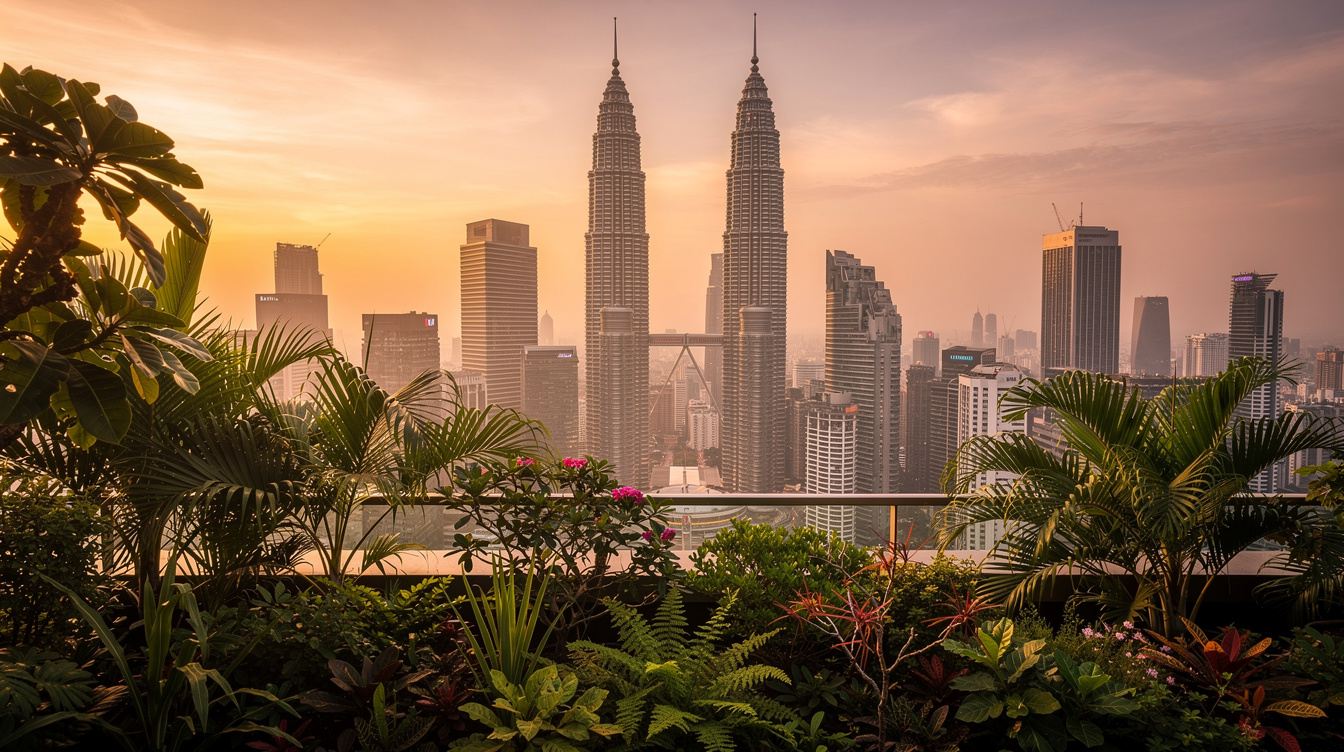
Malaysia My Second Home (MM2H)
MM2H is not a retirement visa in the sense the other Asian long-stay routes are — it is residence by investment, and the marketing rarely says so. There is no income test at any tier. Instead every participant must place a fixed deposit (from USD 150,000 on Silver) AND buy a Malaysian home (from RM 600,000 on Silver) which cannot be sold for ten years. That combined bar is the highest of any long-stay route in this dataset. Two further things the guides get wrong: the entry tier runs FIVE years, not the ten the programme is still widely described as offering, and you cannot apply yourself — every application must go through a licensed MM2H tour operating business.
Malaysia My Second Home (MM2H) at a glance ✓ Verified Aug 2026
- Visa cost
- $1467
- Length of stay
- 60 months
- Official source: mm2h.gov.my · Verified Aug 2026
Requirements
- ⚠ NO INCOME REQUIREMENT EXISTS, at any tier. The bar is capital, and it is two separate commitments — a fixed deposit AND a compulsory property purchase — which most summaries report as one or omit entirely.
- SILVER: fixed deposit USD 150,000 · property from RM 600,000 · participating fee RM 1,000 · pass valid 5 years · minimum age 25.
- GOLD: fixed deposit USD 500,000 · property from RM 1,000,000 · participating fee RM 3,000 · pass valid 15 years · minimum age 25.
- PLATINUM: fixed deposit USD 1,000,000 · property from RM 2,000,000 · participating fee RM 200,000 · pass valid 20 years · minimum age 25. Platinum is the only tier permitted to work, run a business or invest.
- SEZ/SFZ (Forest City, Johor only): fixed deposit USD 65,000 for ages 21–49, or USD 32,000 for ages 50 and above · property in Forest City at the floor price set by Johor state policy · participating fee RM 1,000 · pass valid 10 years.
- ⚠ COMPULSORY PROPERTY PURCHASE at every tier, after approval. The residence may not be sold for 10 years unless it is to upgrade to a more expensive one, and failing any condition revokes the pass.
- Up to 50% of the principal fixed deposit may be withdrawn after approval, and only for a residence, education, medical or tourism spending inside Malaysia.
- ⚠ YOU CANNOT APPLY DIRECTLY. Every application must be submitted through an MM2H tour operating business licensed by the Ministry of Tourism, Arts & Culture under the Tourism Industry Act 1992, via the One Stop Centre. Agent fees are on top of the government fees and are not published anywhere official.
- Minimum presence of 90 cumulative days per year for participants aged 25–49, which may be met between the principal and/or spouse and dependants. No minimum stay for participants aged 50 and above.
- Compulsory medical check-up at a clinic or hospital on the Ministry's panel, for the principal and every dependant, after approval.
- Government fees beyond the participating fee: processing RM 5,000 for the principal and RM 2,500 per dependant, a visa fee of RM 0–50 depending on nationality, and a fixed pass fee of RM 500 per year.
- Open to nationals of any sovereign country holding diplomatic relations with Malaysia. Final immigration approval rests with the Ministry of Home Affairs, not with the tourism ministry that runs the programme.
How to apply
- Pick a tier against the capital you can commit and lock up — the deposit and the property together, not either alone.
- Engage an MM2H tour operating business licensed under the Tourism Industry Act 1992. This is mandatory and there is no direct-application route; ask what the agent charges before anything else, because that figure is published nowhere official.
- The agent submits the application through the One Stop Centre MM2H (OSC MM2H).
- On approval, place the fixed deposit in a Malaysian institution licensed under the Financial Services Act 2013 or the Islamic Financial Services Act 2013.
- Complete the compulsory medical check-up at a Ministry panel clinic or hospital, for the principal and every dependant.
- Purchase and own a qualifying residence at or above your tier's minimum value. It cannot be sold for ten years except to upgrade.
Renewal and long-term stay
- Renewable: yes
The pass is renewable and its validity is additionally bounded by the validity of the participant's passport. The term differs by tier — 5 years on Silver, 10 on the Johor SEZ/SFZ tier, 15 on Gold, 20 on Platinum. ⚠ Whether MM2H leads anywhere permanent is NOT recorded, because the programme's own guidelines do not address permanent residency at all. MM2H is a social visit pass rather than a residence permit, which is a reason to doubt it leads to PR, but it is not a published answer and we do not publish inference as fact.
Applying: where and how
- Apply from outside the country: yes — apply before you travel
- Where you file: either at a consulate or in-country, depending on where you start
- Income requirement as published: no income test at any tier — the bar is a fixed deposit from USD 150,000 plus a compulsory property purchase from RM 600,000
SOURCE: mm2h.gov.my, the Ministry of Tourism, Arts and Culture's own programme site — the category pages for Platinum, Gold, Silver and SEZ/SFZ plus the guidelines page, read 2026-08-26. Currency: government fees are published in ringgit and the deposits in US dollars, so both are recorded in their original currency. cost_usd converts the RM 6,000 of unavoidable government fees at the Silver tier — RM 5,000 processing plus RM 1,000 participating — at RM 4.09 to USD 1, the rate on 26 August 2026. ⚠ THE REAL COST IS NOT KNOWABLE FROM OFFICIAL SOURCES, and that is a finding rather than a gap in our research. Because applications must go through a licensed agent, every applicant pays agent fees on top, and no government page publishes what those are. Any total cost figure you see for MM2H is either government fees only — understated — or an agent quoting their own price. WHY THIS RECORD READS DIFFERENTLY FROM THE MARKETING. Three claims are near-universal and none survives the programme's own guidelines: that MM2H is a ten-year visa (Silver, the entry tier, is five), that it is a retirement visa comparable to Thailand's O-A (it applies no income test and requires a property purchase, which makes it residence by investment), and that it carries a tax exemption (Malaysia's territorial system already exempts foreign-sourced individual income). Note also the state programmes: Sarawak and Sabah run their own MM2H schemes on separate terms, and this record covers the NATIONAL programme only.
Bringing a partner or children
- Dependants: yes — a partner and children can be included
Dependants are unusually broad: spouse; biological, step or adopted children under 21; children aged 21 to 34 provided they are unemployed and single while in Malaysia; medically certified disabled children with no age limit; and parents and parents-in-law. Platinum participants may additionally bring foreign domestic help. There is no income add-on per dependant because there is no income test — the cost of dependants is the RM 2,500 processing fee each, and the 90-day annual presence requirement for under-50s may be satisfied between the principal, the spouse and the dependants rather than by the principal alone.
Tax
- You become tax resident: after 182 days in the country
- Foreign income taxed locally: no — foreign-earned income is not taxed locally
- Special nomad or expat tax regime: no — ordinary resident rates apply
special_tax_regime is FALSE on purpose, and the reason is the most-repeated misconception about this programme. MM2H lists a “tax exemption on foreign funds or income” among its category benefits, and it is routinely sold as an MM2H perk. It is not one: Malaysia taxes territorially and generally exempts foreign-sourced income received by individuals whether or not they hold MM2H. The programme restates the ordinary rule; it does not create a regime. The exemption also has a moving expiry — previously 31 December 2026, extended by Budget 2026 to 31 December 2036 — so confirm the current position with LHDN. Malaysian tax residency attaches at 182 days.
This summarises published rules, not your situation, and it is not tax advice. Two things it can't tell you: your home country may tax you anyway — US citizens are taxed on worldwide income wherever they live — and day-count is only the most common trigger for tax residency, not the only one. Having a permanent home, a family or your centre of economic interests in a country can make you resident well before the day count does. Get advice before you move.
Moving abroad means more than the visa — sort your travel insurance (many visa applications require proof of coverage), set up borderless banking, and land with data working.
First nomad visa? Our digital nomad visa guide explains how qualifying, applying, and taxes work across every country.
Frequently asked questions
What is the income requirement for MM2H?
There isn't one. MM2H applies no income test at any tier, which is why it is better understood as residence by investment than as a retirement visa. What it requires instead is capital in two forms at once: a fixed deposit — from USD 150,000 on Silver, USD 500,000 on Gold, USD 1,000,000 on Platinum, and USD 65,000 or USD 32,000 by age band in the Johor SEZ/SFZ tier — and a compulsory property purchase from RM 600,000, RM 1,000,000 and RM 2,000,000 respectively. Taken together that is the highest bar of any long-stay route we hold a record for.
How long is an MM2H visa valid?
It depends on the tier, and the widely repeated “10-year visa” is no longer the entry offer. Silver runs 5 years, the Johor SEZ/SFZ tier 10 years, Gold 15 years and Platinum 20 years, all renewable, with the pass validity also bounded by the validity of your passport. Anyone quoting a flat ten years for MM2H is describing an older version of the programme.
Do I have to buy a property to get MM2H?
Yes, at every tier, and it is the condition people most often discover late. The purchase is compulsory after approval, the minimum value is set by tier — from RM 600,000 on Silver — and the residence cannot be sold for ten years unless you are replacing it with a more expensive one. Failing any programme condition revokes the pass. The Johor SEZ/SFZ tier requires the property to be in Forest City specifically.
Can I apply for MM2H myself?
No. Every application must be submitted through an MM2H tour operating business licensed by the Ministry of Tourism, Arts & Culture under the Tourism Industry Act 1992, and processed via the One Stop Centre. That is a published rule, not a convention — which also explains why the search results for MM2H are almost entirely agencies. Their fees sit on top of the government fees and are published nowhere official, so ask early.
Does MM2H exempt me from Malaysian tax?
The programme lists a tax exemption on foreign funds and income among its benefits, but read what that actually is. Malaysia taxes territorially and generally exempts foreign-sourced income received by individuals regardless of MM2H — the exemption is a feature of Malaysian tax law, not a privilege the programme confers. The individual exemption has also moved: it was previously due to end on 31 December 2026 and Budget 2026 extended it to 31 December 2036. Confirm the current position with LHDN rather than relying on a programme brochure.
Can I work in Malaysia on MM2H?
Only on Platinum. The programme's own category table permits business, investment and career activity at the Platinum tier — a USD 1,000,000 fixed deposit and a RM 2,000,000 property — and not at Silver, Gold or the Johor SEZ/SFZ tier. If working in Malaysia is the point, the DE Rantau nomad pass or an employment pass is the route, not MM2H.
Other Malaysia long-stay visas
Different visa, different rules. These are routinely confused with each other — check which one a source is describing before you trust a figure from it.
More visas in Asia
Indonesia
Remote Worker Visa (E33G KITAS)
Japan
Digital Nomad Visa
Malaysia
DE Rantau Nomad Pass
Philippines
Special Resident Retiree's Visa (SRRV Classic)
Visa rules, income thresholds, and fees change — always confirm the current requirements on the official government source (linked here) before applying. This page is informational, not immigration advice. See how we verify this data — and tell us if something here is out of date.