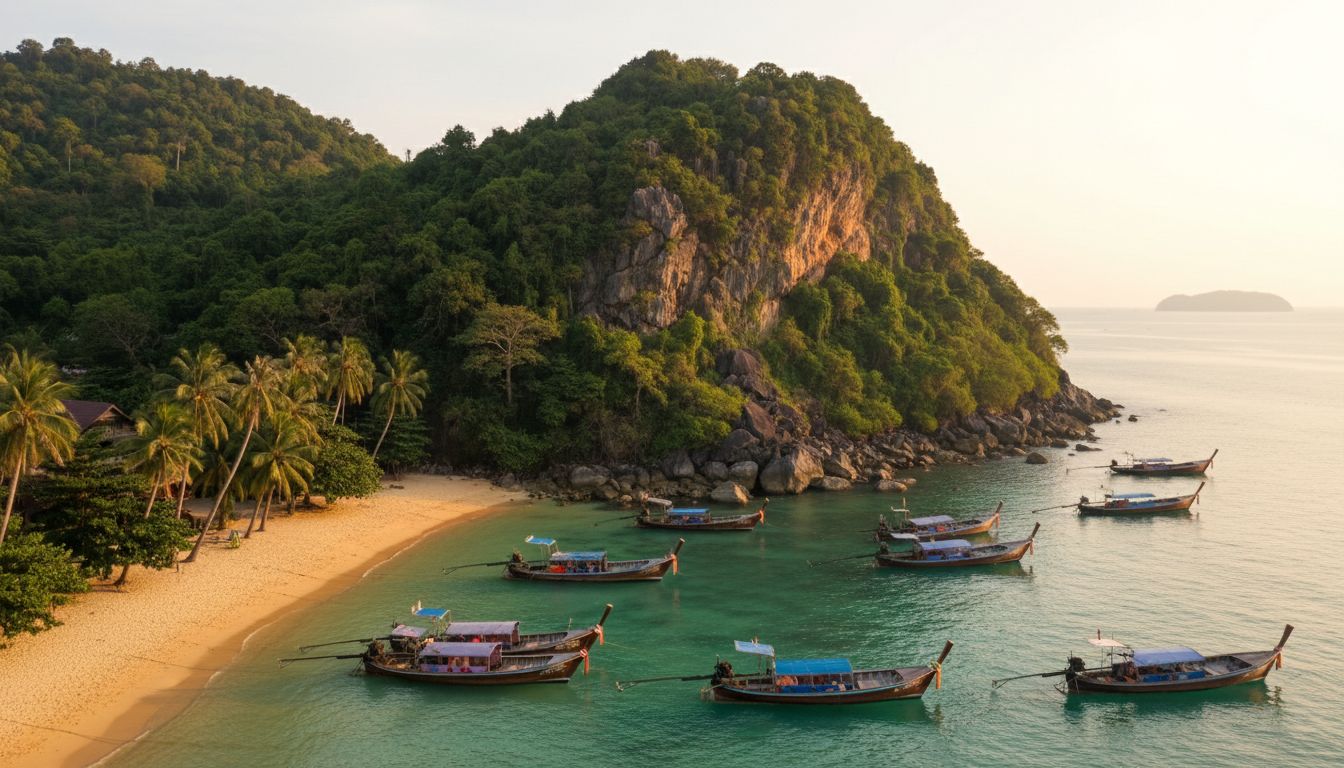
Phuket
Thailand's most expensive province and its worst island for getting around — five separate towns, no usable public transport, and a monsoon coast people misread every year.
- Best months
- Nov – Apr
- Monsoon
- May – Oct
- Getting around
- Own vehicle
- Areas
- 5 compared
- Visa
- Country-issued
- Cost data
- Not yet sourced
The Phuket guide
Phuket is the most expensive province in Thailand and the hardest one to live in without a vehicle, and those two facts are more useful than anything on a cost table. It is not a resort with suburbs — it is five separate towns spread across an island the size of Singapore, with no public transport worth the name between them. Where you live decides which of those towns is your actual life, and almost everyone who is unhappy here picked the wrong one.
Thailand issues the permission to be here, not Phuket — the city does not change what you are allowed to do. Thailand visa programmes →
Which part of Phuket
5 areasRawai & Nai Harn
Southern tipThe long-stay default. A real residential community rather than a resort strip, with the best concentration of people who live here rather than visit.
The catch: It is the far end of the island — the airport is an hour, and anything in the north is a commitment rather than a trip. People who want a scene find it slow.
- Cost, relative
- Mid for the island
- Getting around
- Vehicle. Everything is a ride.
- Who is there
- Long-stayers, families, divers
- Nights
- Quiet, ends early
Chalong
Central-south, inlandPick it for value with access: it sits behind Rawai on the main road junction, so the south of the island is close and the rents are below the coast.
The catch: No beach of its own and no real centre — it is somewhere you live and drive out of, and the main road through it is loud and fast.
- Cost, relative
- Below Rawai
- Getting around
- Vehicle. Main road junction.
- Who is there
- Residents, Thai families
- Nights
- Local, low key
Phuket Town & Kathu
East and inlandPick it for the lowest rents on the island and the only part of Phuket with a genuine town life: the Sino-Portuguese old town, markets, and food that is not priced for tourists.
The catch: You are twenty to thirty minutes from any beach, which sounds trivial and is the reason people leave. Kathu in particular has little English and a housing stock you must see before committing.
- Cost, relative
- Lowest of the five
- Getting around
- Some walking, then a vehicle
- Who is there
- Thai residents, long-term expats
- Nights
- Real, and local
Bang Tao & Cherngtalay
North-west coastPick it for new-build condos, international schools and the closest thing Phuket has to a modern planned community, around the Laguna estate.
The catch: It is the most expensive part of the most expensive province and it is very spread out — nothing is walkable, and the south of the island is a forty-minute drive you will make less often than you plan to.
- Cost, relative
- Highest of the five
- Getting around
- Vehicle. Spread out.
- Who is there
- Families, wealthier expats, newer nomads
- Nights
- Restaurant-led, quiet
Patong
West coast, centralWorth understanding rather than choosing. Everything is walkable and low-season rents drop hard, which genuinely suits a short first stay while you look at the rest of the island.
The catch: It is a tourist strip with the noise, traffic and pricing to match, and the overwhelming majority of people who move here move out within a few months. Treat a lease here as a decision to review, not one to sign for a year.
- Cost, relative
- Swings hardest by season
- Getting around
- Walkable. Then gridlock.
- Who is there
- Tourists, short-stayers
- Nights
- Loudest in Thailand
Transport is the island's real problem
Phuket has no usable public transport. Songthaews run a handful of fixed routes into Phuket Town and nothing helpful between the beaches, and the taxi and tuk-tuk pricing has been a standing local grievance for decades — short trips cost multiples of what the same distance costs in Bangkok. Ride-hailing exists and its coverage and welcome vary by area.
The consequence is that a vehicle is not a convenience here, it is the price of entry, and almost every resident buys or rents one in the first month. That single fact should decide whether Phuket is your island at all: if you will not ride a scooter and do not want a car, Chiang Mai or Bangkok is a much easier life.
It also explains why the areas above matter more than they would in a city. Twenty minutes of driving is a different thing from twenty minutes on a train, and the trip you would make daily somewhere else becomes the trip you make twice a week here.
Where people work, and who you will meet
Phuket's remote-work scene is real but much thinner and more scattered than Chiang Mai's, concentrated around Rawai in the south and Cherngtalay in the north-west. There is no single district where you will meet people by accident, which is the thing Chiang Mai and Canggu do that this island does not.
The population is also older and more settled than the nomad-hub cities: long-term residents, families with children in the international schools, dive and marine businesses, and a large seasonal swing of visitors on top. You will meet fewer people than in Chiang Mai and know them longer.
What is genuinely bad here
The sea, first, because it is the one that kills people. From roughly May to October the monsoon puts strong rip currents on the west-coast beaches, drownings happen every year, and the red flags are frequently ignored by people who have swum there safely in January. Not every beach is patrolled, and the current is not visible from the sand.
The road, second. Thailand's road fatality rate is among the highest in the world, and Phuket adds hills, wet-season surfaces and a lot of inexperienced riders on rented scooters. This is the commonest way a stay here goes badly wrong, and it is largely a matter of what you ride and how.
Then cost and seasonality. Phuket is the most expensive province in Thailand and the price of nearly everything swings with the high season from November to April — accommodation quoted in September and the same unit in January are different numbers. Traffic swings with it, and so does how pleasant the west coast feels.
Healthcare here, specifically
This is the thing Phuket does unusually well. The island is an established medical-tourism destination in its own right, with large private hospitals — Bangkok Hospital Phuket is the one most foreigners name — offering international-standard care, English-speaking staff and specialists you would otherwise travel to Bangkok for.
The bill arrives immediately and in full, which is the part that catches people. Thai private hospitals expect payment or a direct-billing guarantee from an insurer before you leave, and a motorbike accident with surgery is a five-figure event. Check whether a policy direct-bills Thai hospitals rather than reimbursing you afterwards — the difference matters most on the day you cannot argue about it.
And the specific exclusion that catches people here more than anywhere: riding a motorbike without a licence valid for it, plus an International Driving Permit, voids the medical section of most travel and nomad policies. On this island that is the likeliest claim you will ever make.
The 180-day line, and what it costs you here
Thailand's tax residency threshold is 180 days in a calendar year, not the 183 most countries use and most guides copy. People plan to day 182, believe they are outside the net, and are two days inside it.
Cross it and you are a Thai tax resident. Since the 2024 change, foreign income earned from 1 January 2024 onward is taxable when you remit it into Thailand, and how that lands depends on the treaty with your home country. On an island where a year's accommodation already costs more than anywhere else in Thailand, this is the line that decides what the year actually costs.
Phuket adds nothing to the visa question itself — Thailand issues the permission and the island is where you spend it. The routes are listed below, read live from our records rather than summarised here, because summarised visa facts are how the rest of the internet gets them wrong.
What we have not sourced, and why the rows are blank
Thailand publishes no official rental series. REIC and the Bank of Thailand track new-build purchase prices per square metre rather than rents, and the listing portals that do carry rents refuse a plain automated request — DDproperty and Hipflat both returned 403 when we checked, twice.
Phuket is harder than the mainland cities on top of that, because rents here move with the season. A monthly figure quoted in June and one quoted in January are different markets for the same unit, and a single annual number hides that rather than answering it — which is precisely what the sites that fill every cell are doing.
So the rows stay blank until we have five dated submissions from people who actually pay them, each saying which month it refers to. The blank is the ask, and the box under the table is where it goes.
What a month costs
2 unsourcedBlank. Thailand publishes no official rental series, and the listing portals that carry rents refuse a plain automated request (DDproperty and Hipflat both 403, checked 2026-08-14 and again 2026-08-24). Phuket is harder still, because rents here move with the season — a monthly figure quoted in June and one quoted in January are different markets for the same unit, and a single annual number hides that rather than answering it. Publishing at five dated resident submissions, with the month each refers to.
Phuket's coworking is thinner and more scattered than Chiang Mai's, concentrated around Rawai and Cherngtalay, and several spaces quote monthly rates only on enquiry. A scraped headline figure would be a high-season day rate presented as a month. Publishing at five dated submissions.
2 of these lines have no figure yet.
That is deliberate. We publish a cost line when we have a source we would stand behind and a date we checked it, and leave it blank when we don't — rather than averaging numbers we never verified, which is what the figure you'll find elsewhere usually is. If you live in Phuket, these gaps are where a correction is worth the most.
Live in Phuket? Tell us what you actually pay.
One field is enough. No account, no email — we're collecting figures, not reviews, and a real number from one resident beats an average scraped from nobody.
Practical
A scooter or a car, effectively without exception. Songthaews run a few fixed routes into Phuket Town and nothing useful between beaches, and taxi and tuk-tuk pricing here has been a standing complaint for decades — it is the reason residents buy a vehicle in their first month. Carry your home licence and an International Driving Permit: without them the medical section of most travel policies does not pay.
The road and the sea, in that order, and both are genuinely serious here rather than nominally so. Thailand has one of the world's highest road fatality rates and Phuket's hills and wet season make it worse. On the west coast, monsoon rip currents drown people every year — the red flags are not decorative and the beaches are not all patrolled.
Thai Baht. Foreign-card ATM withdrawals carry a fixed fee around ฿220 whatever the amount. Cards are fine in the tourist west and in the malls, and cash still matters in Kathu and Phuket Town.
Home fibre is cheap, quick to install and generally as advertised, which is the one piece of infrastructure Phuket does better than its transport. Ask which provider actually reaches the building before signing — coverage is address-by-address in the newer developments.
Common questions
Which part of Phuket is best to live in?
Rawai and Nai Harn in the south for a settled long-stay community, which is where most people who stay a year end up. Chalong just behind it for the same access at lower rents. Phuket Town and Kathu for the cheapest rents and the only genuine town life on the island, at the cost of being twenty minutes from a beach. Bang Tao and Cherngtalay for new-build condos and international schools, at the highest prices. Patong is worth understanding and rarely worth a year.
Do I need a car or scooter in Phuket?
Yes, in practice. There is no usable public transport between the beaches, songthaews serve only a few fixed routes into Phuket Town, and taxi and tuk-tuk pricing is a standing local grievance — which is why almost every resident buys or rents a vehicle in their first month. If you will not ride a scooter and do not want a car, Phuket is a significantly harder place to live than Chiang Mai or Bangkok. Carry your home licence and an International Driving Permit, because riding without them voids the medical cover on most policies.
Is Phuket expensive compared with the rest of Thailand?
Yes — it is the most expensive province in the country, and the price of most things swings with the high season from November to April. We do not publish a monthly figure for Phuket because a single annual number hides that swing rather than answering it: the same unit quoted in September and in January is a different price. Our cost lines stay blank until we have dated resident submissions that say which month they refer to.
Is it safe to swim in Phuket?
Seasonally. From roughly May to October the monsoon puts strong rip currents on the west-coast beaches and drownings happen every year, frequently to people who swam the same beach safely in the dry season. Red flags mean do not enter the water, not all beaches are patrolled, and a rip is not visible from the sand. In the November to April high season the same beaches are generally calm.
What is healthcare like in Phuket?
Unusually good. Phuket is an established medical-tourism destination with large private hospitals — Bangkok Hospital Phuket is the one most foreigners use — offering international-standard care and English-speaking specialists. The catch is billing: Thai private hospitals expect payment or an insurer's direct-billing guarantee before you leave, and a motorbike accident with surgery is a five-figure event. Check that a policy direct-bills Thai hospitals rather than reimbursing you later.
When do I become a Thai tax resident living in Phuket?
At 180 days in a calendar year — not the 183 days most countries use and most guides repeat. Once resident, foreign income earned from 1 January 2024 onward is taxable when you remit it into Thailand, which closed the old route of bringing money in the following year. How your own pension or salary is treated depends on the double-tax treaty with your home country, so take advice before moving money rather than after.