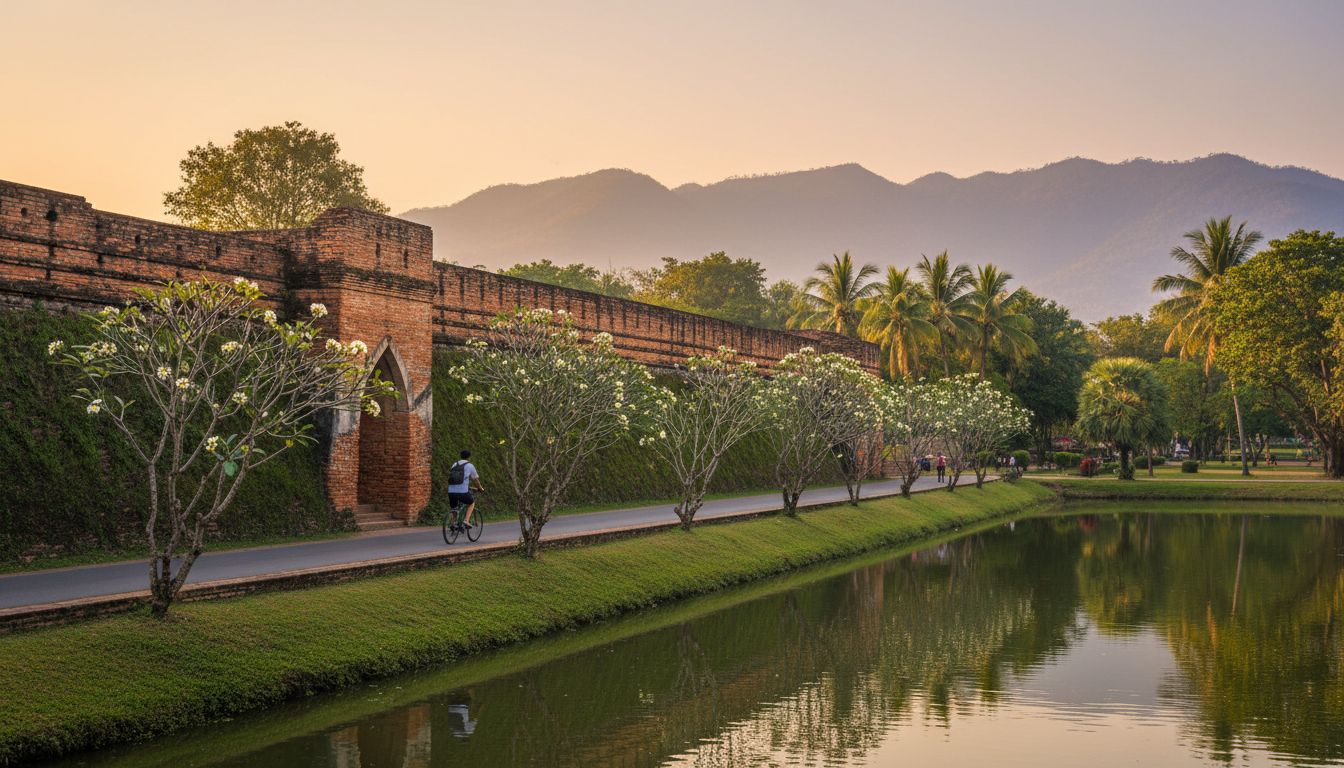
Chiang Mai
Thailand's cheapest serious base and the one most remote workers try first — walkable, green, and genuinely unbreathable for three months a year.
- Best months
- Nov – Jan
- Avoid
- Feb – Apr
- Getting around
- Scooter
- Neighbourhoods
- 4 compared
- Visa
- Country-issued
- Cost data
- Nimman rent sourced
The Chiang Mai guide
Chiang Mai is the first place most people try when they move to Thailand, and it deserves that. It is small enough to cross in twenty minutes, cheap enough that the maths stops being a worry, and it has the largest settled remote-work community in the country. It also has a burning season that turns the air hazardous every February, and no honest guide to living here can put that anywhere but near the top.
Thailand issues the permission to be here, not Chiang Mai — the city does not change what you are allowed to do. Thailand visa programmes →
Which neighbourhood
4 areasNimmanhaemin
West of the moatOur default pick, and the least surprising recommendation in Thailand. Cafes, coworking, condos and food within one walkable grid.
The catch: It is the least Thai part of Chiang Mai, and after a few months a lot of people move out of it deliberately.
- Cost, relative
- Highest in the city
- Getting around
- Walkable. Scooter optional.
- Who is there
- Remote workers and students
- Nights
- Busy, but ends early
Old City
Inside the moatPick it for the version of Chiang Mai you came for — temples, small lanes, morning markets, and rents below Nimman.
The catch: Tourist traffic never stops, buildings are older with weaker aircon and insulation, and parking a vehicle is a daily problem.
- Cost, relative
- Below Nimman
- Getting around
- Walkable inside the moat
- Who is there
- Tourists, retirees, monks
- Nights
- Quiet, bar two streets
Santitham
North of the moatPick it if you want Nimman's walk-in radius at local prices and can live without the polish.
The catch: Little English, few cafes you would work a full day from, and the housing stock is a lottery — see the unit before you commit to anything.
- Cost, relative
- Lowest of the four
- Getting around
- 15 min walk to Nimman
- Who is there
- Thai families, long-stayers
- Nights
- Local. Street food late.
Hang Dong & Mae Rim
20–40 min outPick it for a house with a garden, which is the one thing the city proper cannot give you at any price.
The catch: Every errand is a drive, the smoke sits worse in the valley than in town, and you will see people far less than you expect to.
- Cost, relative
- Cheap space, costly commute
- Getting around
- Vehicle mandatory
- Who is there
- Families, long-term residents
- Nights
- Silent
Burning season is the decision, not a footnote
From roughly mid-February to mid-April, agricultural burning across northern Thailand and over the border fills the valley with smoke, and Chiang Mai regularly posts some of the worst measured air quality of any city in the world during those weeks. The mountains that make the place beautiful are what trap it.
People who live here well do one of three things: leave for those two months, stay indoors with sealed rooms and air purifiers, or accept the health cost knowingly. What almost nobody does is arrive in February without having heard about it, which is why it is this high on this page.
The rest of the year the air is good — better than Bangkok's, in a valley with forest on three sides. Judging Chiang Mai on its worst ten weeks is as wrong as judging it on its best forty.
The city is small, and that is most of the appeal
You can cross Chiang Mai in twenty minutes on a scooter and walk most of the places you would actually live in. That single fact is why people who move here from Bangkok rarely go back: the hour a day Bangkok takes in transit is simply returned to you.
There is no metro and there will not be one. A scooter is the default and a licence plus an International Driving Permit is the legal minimum — riding without one voids most travel insurance, which is a more expensive mistake than the fine.
Where people actually work from
Chiang Mai has more coworking space per head than anywhere else in Thailand, clustered in Nimman and along the Huay Kaew end. Cafes are openly laptop friendly here in a way they are not in Bangkok's malls, and a lot of people never buy a desk at all.
Home fibre is cheap and installed within days. The variable is the building rather than the city, and older units inside the moat are where people most often find the connection does not match the advertisement.
Where the rent figure comes from, and what is still missing
The Nimman rent comes from 10 one-bedroom condo listings on DDproperty, a Thai property portal, read one at a time in September 2026. Nimman here means Nimmanhaemin Road and its sois, plus Siri Mangkalajarn Road, the parallel street one block east. For each listing we noted the building, size, floor, furnishing, asking price in baht and the date it was last posted. We read fifteen and dropped five: two repeat postings of one unit that three agents were advertising, one that may be another unit's second posting, a 146 square metre flat with two bathrooms and an office that is a one-bedroom in name only, and an office space listed as a condo.
These are portal asking prices: what a foreigner searching the listings sees, not the price a Thai tenant would negotiate for the same unit, and not what anyone pays after negotiating. Thailand publishes no official rental series to check them against. All ten are furnished, eight ask between ฿17,000 and ฿25,000 a month, and eight ask for a one-year lease. Six of the ten are listed by the same letting agency.
We tried the old city next, inside the moat, and could not source it. On 30 September 2026 neither DDproperty nor FazWaz listed a single one-bedroom rental inside the moat: the only one-bedroom condos in the two subdistricts that contain it were in one building just north of the moat. The rest of what FazWaz lists in those subdistricts is mostly houses, shophouses, hotels and commercial space.
The neighbourhood cost lines on this page are still relative judgements and are labelled that way. Coworking has no figure yet. DDproperty refuses a plain automated request but reads normally in a browser, which is how these were read. FazWaz reads the same way and was not needed for Nimman, so this figure rests on one portal.
If you rent in Nimman and our figure is wrong for your building, the box under the cost table is where to tell us.
What a month costs
1 unsourcedPortal asking prices from 10 one-bedroom condo listings in Nimman, read one by one in September 2026 — the price a foreigner searching the portal sees, not the price a Thai tenant would negotiate for the same unit, and not what anyone ends up paying after negotiating. All ten are furnished, they run from 31 to 62 sqm, and eight ask between ฿17,000 and ฿25,000. Eight ask for a one-year lease; one is advertised as a short-term rental. Two say water and electricity are billed on top at metered rates and eight don't say, so ask. The old city could not be sourced: on 30 September 2026 neither DDproperty nor FazWaz listed a one-bedroom rental inside the moat. The other districts are not sourced yet.
Chiang Mai has more coworking per head than anywhere else in Thailand, which makes the missing figure more annoying rather than less. Published rates move with promotions and several spaces quote only on enquiry, so a single scraped number would be wrong within a month. Publishing at five dated submissions.
1 of these lines has no figure yet.
That is deliberate. We publish a cost line when we have a source we would stand behind and a date we checked it, and leave it blank when we don't — rather than averaging numbers we never verified, which is what the figure you'll find elsewhere usually is. If you live in Chiang Mai, this gap is where a correction is worth the most.
Live in Chiang Mai? Tell us what you actually pay.
One field is enough. No account, no email — we're collecting figures, not reviews, and a real number from one resident beats an average scraped from nobody.
Practical
Songthaews flag down anywhere in town and Grab works everywhere. A scooter is the default for residents — carry your home licence and an International Driving Permit, because riding without them voids the medical cover on most travel policies.
Low crime and low hassle by the standards of any city this size. The things that actually catch people are rental-scooter damage claims and deposits on year leases, not street crime.
Thai Baht. Foreign-card ATM withdrawals carry a fixed fee of around ฿220 regardless of amount, so take out more, less often. Cash still matters outside malls and chains.
Home fibre is cheap and installed within days, and the advertised speed is broadly the real one. The variable is the building rather than the city — older units inside the moat are where it most often disappoints.
Common questions
Is Chiang Mai still good for remote work?
Yes, and it is still the cheapest serious option in Thailand. The community is the largest and longest-established in the country, coworking is dense and inexpensive, and home fibre is quick to install and reliable. The honest caveat is burning season: for roughly ten weeks from mid-February the air is hazardous, and most long-term residents plan to be elsewhere.
Which neighbourhood should I stay in first?
Nimmanhaemin, unless you have a specific reason not to. It is the one part of the city where you can live without a scooter, it puts coworking and food inside a walkable grid, and it is the easiest place to meet people in your first month. It is also the most expensive and the least Thai — plenty of people start there and move to Santitham or the old city once they know the city well enough to choose.
Do I need a scooter in Chiang Mai?
In Nimman, no. Everywhere else, effectively yes — there is no metro, buses are not a practical daily option, and ride-hailing gets expensive if it is your only transport. If you do ride, carry your home licence and an International Driving Permit: riding without them is not just a fine, it voids the medical cover on most travel and nomad insurance policies.
How bad is the air, really?
For about ten weeks from mid-February, bad enough that Chiang Mai regularly appears at the top of global worst-air-quality rankings, driven by agricultural burning and a valley that traps the smoke. Outside that window the air is better than Bangkok's. Residents either leave for those weeks, or seal a room and run purifiers — both are normal here, and planning for it is the difference between a good year and a bad one.