Yogyakarta
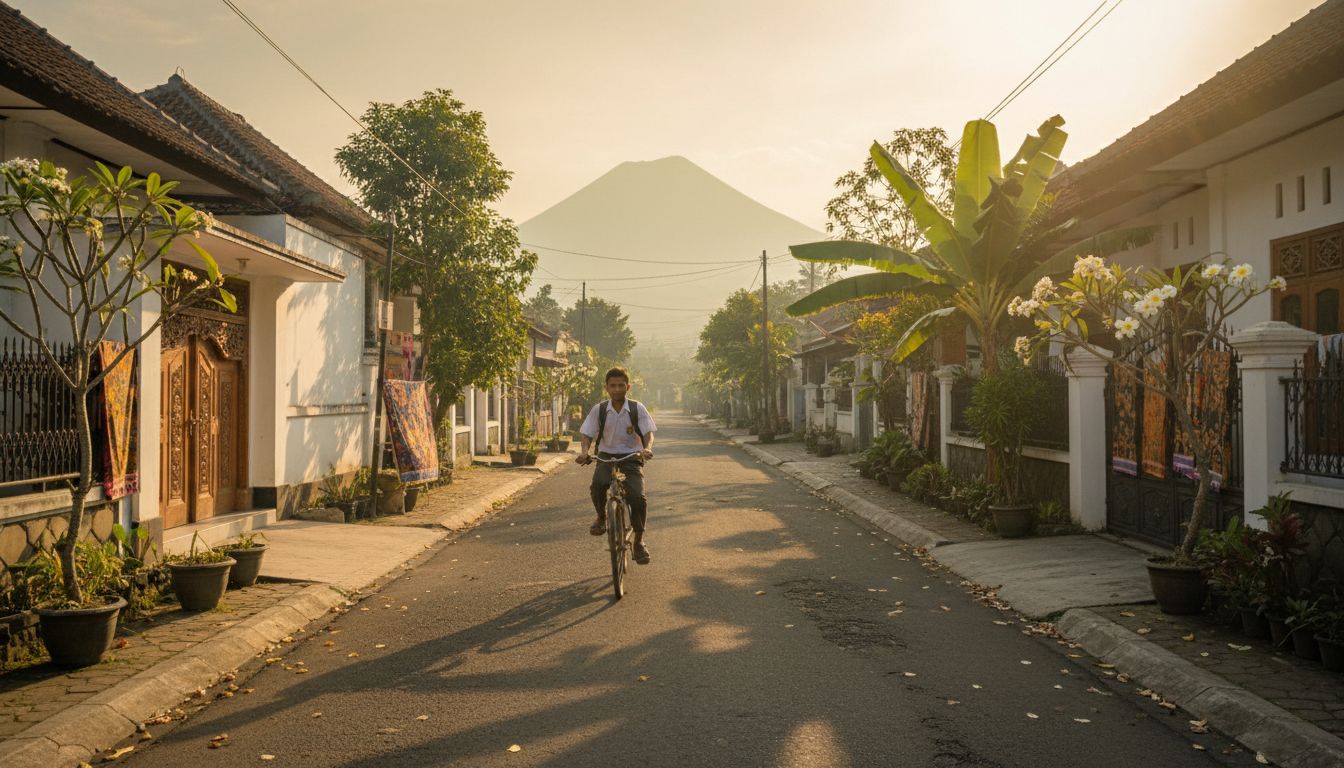
Java's student city and the cheapest serious base in Indonesia — arts, a living monarchy, an active volcano on the skyline, and no beach.
- Best months
- Apr – Oct
- Wettest
- Nov – Mar
- Getting around
- Scooter
- Neighbourhoods
- 4 compared
- Visa
- Country-issued
- Cost data
- Not yet sourced
The Yogyakarta guide
Yogyakarta is the cheapest serious base in Indonesia and the reason is structural rather than lucky: it is a university city of several hundred thousand students, and an entire rental and food economy is priced for people who cannot pay much. It is also the cultural centre of Java, the country's only province still led by a Sultan, and about an hour from the south coast rather than on it. Everyone weighing it against Bali is really weighing those two things — the price and the missing beach.
Indonesia issues the permission to be here, not Yogyakarta — the city does not change what you are allowed to do. Indonesia visa programmes →
Which neighbourhood
4 areasPrawirotaman
South of the centreWhere almost every foreigner starts and most stay: two parallel streets of cafes, guesthouses and coworking, walkable, and the one part of the city set up for someone who has just arrived.
The catch: Small, and priced for visitors rather than residents — you can exhaust it in a fortnight, and staying only here means missing the city that makes Yogyakarta worth choosing.
- Cost, relative
- Highest in the city
- Getting around
- Walkable. Scooter optional.
- Who is there
- Foreigners, long-stay travellers
- Nights
- Low key, ends early
Kraton & Malioboro
The historic centrePick it to live inside the old city itself — the Sultan's palace quarter, batik workshops, markets, and the densest street life in Java outside Jakarta.
The catch: Tourist crowds on Malioboro never let up, the lanes are narrow and noisy, and the housing stock inside the kraton walls is old in the difficult sense as well as the beautiful one.
- Cost, relative
- Mid, varies hugely
- Getting around
- Walkable, congested
- Who is there
- Javanese residents, tourists
- Nights
- Busy and late
Seturan & Condongcatur
North, in SlemanPick it for the lowest rents and the most modern amenities: this is where the universities are, so it has the newest buildings, the best internet and food priced for people with no money.
The catch: Overwhelmingly young and almost entirely Indonesian-speaking, with little of the old city's character — and term-time noise is a real factor rather than a joke.
- Cost, relative
- Lowest of the four
- Getting around
- Scooter needed
- Who is there
- Students, young Indonesians
- Nights
- Late, cheap, loud
Jalan Kaliurang
Far north, toward MerapiPick it for space, trees and noticeably cooler air as the road climbs toward the volcano — the closest thing to a rural life within reach of a city.
The catch: Everything is a ride, the road into town is slow at peak hours, and this is the side of the city that gets ash when Merapi is active.
- Cost, relative
- Below Prawirotaman
- Getting around
- Scooter mandatory
- Who is there
- Families, academics, long-stayers
- Nights
- Silent
It is cheap because it is a student city
Yogyakarta holds one of the largest concentrations of universities in Indonesia, and several hundred thousand students set the price of everything. Rent, food, transport and services are calibrated to people living on an allowance, which is why this is the cheapest serious base in the country and why the gap to Bali is as wide as it is.
That shapes the housing market in a way worth knowing before you look. The dominant format is the kos — a room in a shared house, let by the month or the year, advertised on a sign at the gate rather than on any website. A Western-style one-bedroom and a kos on the same street are different products at different prices, and the second one is invisible to every listing site.
It also sets the tone. The city skews young, the nightlife is cheap and early, and there is a real arts and music scene running underneath it that has nothing to do with tourism. People who find Bali thin usually mean this is what was missing.
Where people work, and who you will meet
The remote-work scene is small, concentrated in Prawirotaman, and genuinely cheap — nothing like Canggu's density and nothing like its prices either. Coworking exists, cafes are laptop-friendly, and the internet in the student districts is good because the universities forced it to be.
What is unusual here is the mix. Foreigners in Yogyakarta skew toward researchers, language students, artists and people on their second or third year in Indonesia rather than first-timers, and the Indonesian student and arts scene is far more open to outsiders than Bali's tourist economy is. You will meet fewer foreigners and more Indonesians, which for a lot of people is the entire point.
What is genuinely bad here
There is no beach. The south coast is about an hour away and the Indian Ocean surf there is dangerous rather than swimmable, with rip currents that drown people every year. If a swimmable coastline is part of why you are looking at Indonesia, this city cannot supply it and no amount of cheapness compensates.
Merapi. One of the most active volcanoes in the world sits on the northern skyline, and it erupts on a scale that closes the airport and drops ash across the city every few years, with evacuation zones on the upper slopes. It is monitored closely and the city itself has not been in serious danger in living memory — but ash, disruption and cancelled flights are a normal part of living here rather than a freak event. Central Java is also seismically active; the 2006 earthquake killed thousands in this region.
Then the ordinary frictions: hot and humid year-round with no coastal breeze, traffic that has grown faster than the roads, and few international flights — most journeys out of the country route through Jakarta or Bali, which adds a leg to everything.
Healthcare here, specifically
Better than a city this size would suggest, and the universities are the reason: Yogyakarta has teaching hospitals alongside private ones, with specialists that a comparable non-university city would not support. Routine and moderately serious care is handled competently and cheaply, and English is available at the private hospitals foreigners use.
The tail still leaves the city. For complex surgery, specialist oncology or cardiac intensive care, the route is Jakarta or an evacuation to Singapore, and an air ambulance is a five-figure bill — with the added wrinkle that Merapi ash has closed this airport before, which is not a consideration anywhere else on this site.
Check the evacuation limit on a policy rather than its headline coverage figure, and check that motorbike use is covered — riding without a licence valid for the bike plus an International Driving Permit voids the medical section of most policies, and a scooter is how you will get around here.
The visa is Indonesia's, and the bar is the same everywhere
Nothing about Yogyakarta changes what you are allowed to do — Indonesia issues the permission and this is where you spend it. The E33G remote worker KITAS is a genuine one-year residence permit with a substantial income requirement, written around employees rather than freelancers, and it bars Indonesian clients and customers entirely.
Below that bar the answer is what it is everywhere in the country: a tourist e-visa, or a social-cultural route through an agent. Both are legal, neither is residence, and nothing accrues. The full version of that argument, with the current figures read from our records, is on the Indonesia guide linked from this page.
One local note that is genuinely different from Bali: the student and research route. Yogyakarta's universities sponsor study and research permits at a volume no other Indonesian city matches, which is why the foreign population here skews toward people whose paperwork has an institution behind it.
The 183-day rule may not be the test that catches you
Almost everyone plans around a day count. Indonesia has one — 183 days in any twelve-month period — and it also has a second trigger with no days attached: being present during a fiscal year and intending to reside in Indonesia.
A KITAS is a residence permit, and applying for one and living on it is the kind of thing that evidences intent. So the practical question may not be whether you crossed day 184; it may be that the permit answered it before you started counting. Residents are taxed on worldwide income.
We are stating the trigger, not predicting your outcome. How intent gets assessed in a particular case, and how your home country's treaty interacts with it, is where general guidance stops being worth anything and a local accountant starts.
What we have not sourced, and why the rows are blank
Indonesia publishes no official rental series, and Yogyakarta is the hardest city on this site to cost for a reason that is specific to it: the dominant rental format is the kos, a room in a shared house advertised on a sign at the gate. It is priced against a student market and it does not appear on any listing site.
So the figures that exist online are Western-style apartments marketed to foreigners — a real product, but a small and unrepresentative slice of how people actually live here. Publishing one as the city's rent would overstate it substantially, which is exactly what the cost-of-living sites do and never disclose.
The rows publish at five dated resident submissions, each naming whether it is a kos or a full apartment, and the box under the table is where they go. That distinction is the whole answer here, and nobody has published it.
What a month costs
2 unsourcedBlank for the same reason as Bali's, with one Yogyakarta-specific wrinkle that makes a single figure worse than useless here: the dominant rental format is the kos — a room in a shared house, let by the month or the year, advertised on a sign at the gate rather than on any portal — and it prices against a student market, not an expat one. A Western-style one-bedroom and a kos on the same street are different products at different prices, and no listing site captures the second. Publishing at five dated resident submissions, each naming which of the two it is.
Yogyakarta's coworking market is small and cheap, clustered around Prawirotaman and the northern student districts, with rates commonly quoted on enquiry. Publishing at five dated submissions.
2 of these lines have no figure yet.
That is deliberate. We publish a cost line when we have a source we would stand behind and a date we checked it, and leave it blank when we don't — rather than averaging numbers we never verified, which is what the figure you'll find elsewhere usually is. If you live in Yogyakarta, these gaps are where a correction is worth the most.
Live in Yogyakarta? Tell us what you actually pay.
One field is enough. No account, no email — we're collecting figures, not reviews, and a real number from one resident beats an average scraped from nobody.
Practical
A scooter, and this is one of the gentler Indonesian cities to ride in — flat, moderate traffic by national standards, and short distances. Ride-hailing on both car and bike is cheap and works properly here. Carry your home licence and an International Driving Permit: without them the medical section of most travel policies does not pay.
Notably calm, including at night, and one of the easier cities in the region for a newcomer. The real hazards are the road and the south-coast beaches, where the Indian Ocean surf and rip currents are genuinely dangerous and drownings happen — these are not swimming beaches in the way Bali's are.
Indonesian Rupiah. Cash matters more here than in Bali because far less of the economy is tourist-facing, though QR payment is now common. Use bank-branded ATMs inside bank premises rather than standalone machines.
Fibre is available and cheap across the city and the student districts are well served, which is a side effect of the universities. Coverage is address-by-address rather than area-wide, so confirm which provider reaches the building before signing, and expect occasional power cuts.
Common questions
Which area of Yogyakarta should I live in?
Prawirotaman if you have just arrived — it is the foreigner quarter, walkable, with cafes and coworking, at the city's highest prices. Seturan and Condongcatur in the north are the cheapest with the most modern amenities, because that is where the universities are. The Kraton and Malioboro area puts you inside the old walled city with the noise and crowds that come with it. Jalan Kaliurang to the north is cooler, greener and further from everything.
Is Yogyakarta cheaper than Bali?
Substantially, and the reason is structural rather than seasonal: Yogyakarta is a university city where several hundred thousand students set the price of rent, food and transport, while Bali prices against a global visitor economy. We do not publish a monthly figure for either, because the dominant rental format here — the kos, a room in a shared house advertised at the gate — appears on no listing site, so every published Yogyakarta figure describes a small expat slice instead.
Is Yogyakarta good for remote work?
Yes, with two honest caveats. Internet is good, the city is cheap and calm, and it has a real arts and student culture that Bali's tourist economy does not. But the remote-work community is small and concentrated in Prawirotaman, and there are few international flights — most journeys out route through Jakarta or Bali. It suits someone on their second or third year in Indonesia better than a first-timer.
Is it dangerous to live near Mount Merapi?
The volcano is one of the most active in the world and it erupts on a scale that closes the airport and drops ash across the city every few years, with evacuation zones on the upper slopes. It is closely monitored and the city itself has not been in serious danger in living memory, but ash, disruption and cancelled flights are a normal part of living here rather than a freak event. Central Java is also seismically active — the 2006 earthquake killed thousands in this region.
Does Yogyakarta have a beach?
No, and this is the main reason people choose Bali instead. The south coast is about an hour away, and the Indian Ocean surf there is dangerous rather than swimmable — strong rip currents drown people every year and these are not swimming beaches in the way Bali's are. If a swimmable coastline is part of why you are looking at Indonesia, no amount of cheapness here compensates for it.
Can I legally live in Yogyakarta as a remote worker?
On the same terms as anywhere in Indonesia — the visa is national, not local. The E33G remote worker KITAS is a genuine one-year residence permit with a substantial income requirement, written around employees rather than freelancers, and it bars Indonesian clients entirely. Below that bar people use a tourist e-visa or a social-cultural route through an agent; both are legal and neither is residence. Yogyakarta's universities also sponsor study and research permits at a volume no other Indonesian city matches.