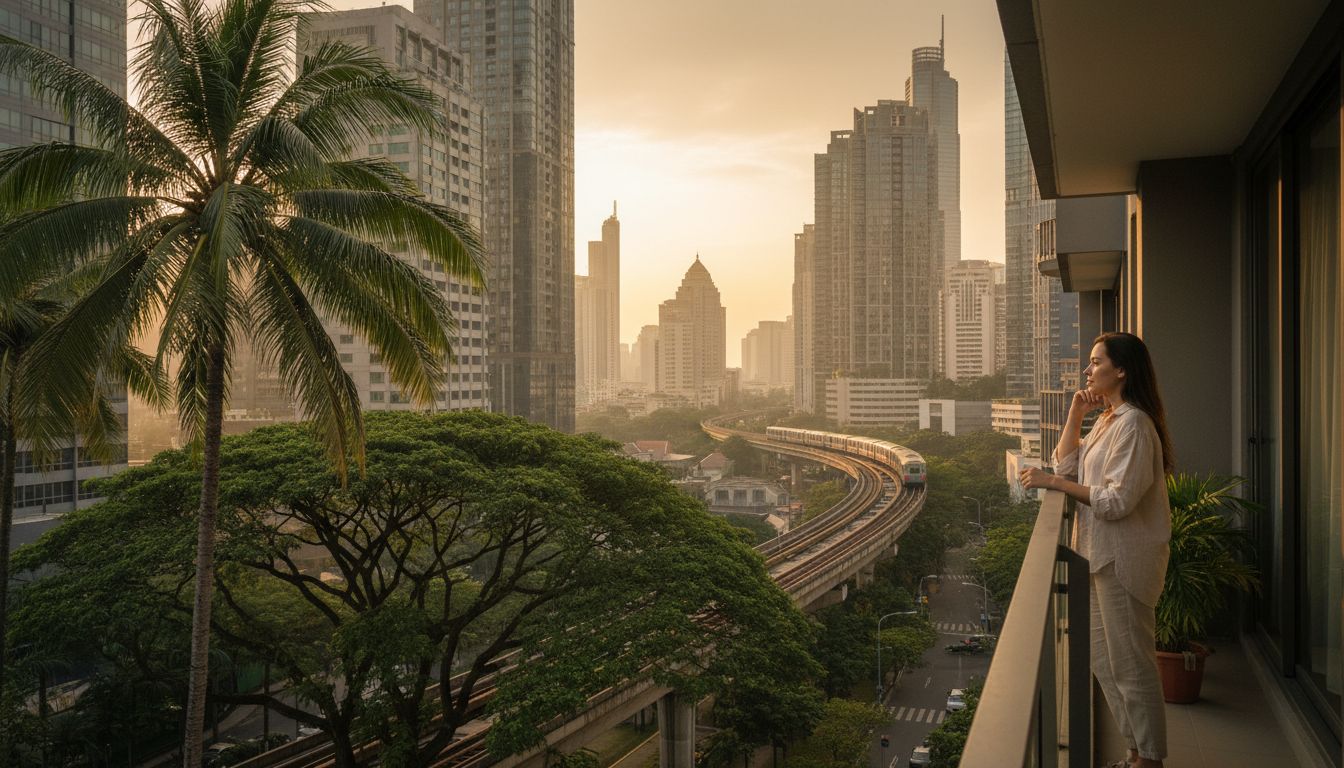
Jakarta
Still Indonesia's capital, whatever you have read about Nusantara — a court confirmed it in May 2026. Thirty million people, a real metro that does not reach most of them, and some of the worst air of any city on this site.
- Best months
- Jun – Sep, driest
- Hardest months
- Jan – Feb, floods
- Getting around
- MRT, LRT, BRT, and traffic
- Neighbourhoods
- 5 compared
- Visa
- E33G remote worker
- Cost data
- Not yet sourced
The Jakarta guide
Jakarta is the city people move to Indonesia for work and move to Bali to avoid, and both halves of that are fair. Thirty million people live in the greater metropolitan area, the professional depth is not close to anywhere else in the country, and the daily costs are traffic and air rather than rent. The first thing to clear up is the one most articles get wrong: this is still the capital, and a court said so in May 2026.
Indonesia issues the permission to be here, not Jakarta — the city does not change what you are allowed to do. Indonesia visa programmes →
Which neighbourhood
5 areasSCBD & Sudirman
The business spineOur default for a first move and the one part of Jakarta built around the train. The corporate towers, the serviced apartments and the MRT are in the same few streets, which in this city is worth more than square metres.
The catch: You are paying top rent for a district that is an office park after dark, with very little that is not a tower, a mall or a hotel, and the pavements give out the moment you step off the main axis.
- Cost, relative
- Highest of the five
- Rail access
- MRT through the middle of it
- Who is there
- Corporate expats, finance, embassies nearby
- Nights
- Rooftop bars, and it empties at weekends
Menteng
Old Jakarta, north of the CBDPick it for a neighbourhood rather than a development. Menteng is the colonial-era garden district — wide streets, mature trees, low-rise houses, embassies and the closest thing this city has to walkable charm.
The catch: Expensive for what is often ageing housing stock, thin on modern apartment options, and the calm is relative — the arterial roads that bound it carry the same traffic as everywhere else.
- Cost, relative
- High, on houses not units
- Rail access
- MRT at the southern edge
- Who is there
- Diplomats, established families, old money
- Nights
- Restaurants, quiet, residential
Kemang
South, the expat stripPick it if the social life is the point. Kemang has the bars, the independent restaurants, the galleries and the longest-standing foreign community in the city, in a low-rise area you can actually walk around.
The catch: No rail at all, one congested main road through the middle, and it floods — Kemang sits low and the wet season reaches it most years, which is the specific reason to care which floor you are on.
- Cost, relative
- Mid to high
- Rail access
- None — nearest is a drive
- Who is there
- Long-term expats, creatives, younger arrivals
- Nights
- The best in Jakarta, and late
Pondok Indah
Far south, the school beltPick it if you have children. The international schools, the largest houses in the city, the malls and Pondok Indah Hospital are all here, which is why the school-age expat population is concentrated in this one district.
The catch: It is a long way south, so anything in the centre is a serious drive at the wrong hour, and the district is suburban in the fullest sense — very little happens here that was not driven to.
- Cost, relative
- High, family houses
- Rail access
- MRT terminus nearby at Lebak Bulus
- Who is there
- School families, corporate transfers
- Nights
- Malls and restaurants, early
Pantai Indah Kapuk
North coast, reclaimed landPick it for new-build density and the best concentration of food in the city. PIK is where Jakarta has been building fastest — modern towers, planned streets, and a genuinely good restaurant scene rather than a mall food court.
The catch: It is in North Jakarta, which is the part of the city that is sinking fastest and flooding worst, and it is reached by toll road rather than rail — so a jam on the way in has no alternative.
- Cost, relative
- Mid, newest stock
- Rail access
- None — toll road in and out
- Who is there
- Younger professionals, Chinese-Indonesian community
- Nights
- Busy, food-led, newest openings
Jakarta is still the capital, whatever you have read
This is the most-repeated wrong fact about the city and it is worth getting straight before anything else. Indonesia legislated in 2022 to move its capital to Nusantara in East Kalimantan, and a great deal of coverage since has written about Jakarta in the past tense.
The law itself says otherwise. Article 39(1) of the IKN Law keeps the position, function and role of the national capital in Jakarta until the president issues a decree transferring it — and in May 2026 the Constitutional Court rejected a judicial review and confirmed exactly that. No decree has been issued. Jakarta is the capital.
Nusantara is real and is being built: the legislative and judicial complex is targeted for 2027 with a final deadline in the first half of 2028. But for anyone deciding where to live, work, register a business or visit an embassy this decade, the institutions are here. Treat 'Jakarta is no longer the capital' as a signal that whatever you are reading was not checked.
The transport genuinely improved. The traffic did not.
Jakarta spent the last decade building the public transport it spent the previous four decades without, and the result is real. One MRT line runs north–south under the business spine from Lebak Bulus to Bundaran HI, TransJakarta's bus rapid transit is among the largest networks of its kind anywhere, KRL commuter trains reach deep into the satellite cities, and LRT Jabodebek serves the eastern suburbs.
The extension is under way and it is slow. MRT Phase 2A, carrying the line north from Bundaran HI to Kota, stood at 61.8 per cent complete on 25 June 2026, with trial running on the Bundaran HI–Monas section targeted for June 2027, the Harmoni segment operational by the end of 2027 and the run to Kota Tua targeted for the end of 2029.
None of which has fixed the traffic, because thirty million people in the greater metropolitan area is a bigger number than one metro line. The practical shape of life here is the same as Manila's: live in the district you need to be in, treat crossing the city as an event rather than a commute, and use a motorbike taxi when the car is hopeless. What is different from Manila is that in a few districts the train genuinely is the answer.
What is genuinely bad here
The air, and it is the worst of any city on this site. Jakarta ranked third worst in the world for air pollution on 20 August 2026 and second worst on a day in June, and one measurement during the 2026 dry season put PM2.5 at 11.9 times the World Health Organization guideline. This is not a haze season that arrives and passes, as in Malaysia — it is the ordinary condition of a megacity with heavy traffic and coal-fired power close by, and it is the single clearest reason for anyone with a respiratory condition to be looking elsewhere in Indonesia.
Then the ground. North Jakarta is subsiding and the published rates disagree with each other — around 4.9 cm a year on one estimate, an 11 cm annual average for 2016 to 2019 on another, and up to roughly 20 cm a year in the worst north-western pockets. We are giving you the spread rather than picking one, because the sources genuinely conflict and the direction is what matters: the northern districts, including the newest and most fashionable ones, are going down while the sea is coming up.
Which brings the flooding, concentrated in January and February. It is routine rather than exceptional, it is worse in the north and in the low-lying southern pockets like Kemang, and it is the reason a ground or first-floor unit is a materially different proposition here than three floors up.
Healthcare here, specifically
Jakarta has the best hospitals in Indonesia and that is a lower bar than it sounds. Pondok Indah Hospital's two campuses, the Siloam network and Mayapada are what the foreign community actually uses, and they hold international accreditation — worth confirming against Joint Commission International's own directory rather than taking from any website, including this one, since accreditations lapse and get renewed.
The honest part is what happens above a certain complexity. Serious cases are routinely evacuated to Singapore, with Mount Elizabeth and Gleneagles the usual destinations, and that is a standard expectation here rather than a worst case. It is the sharpest contrast on this whole site with Malaysia, where the argument for the country is that the complex treatment happens where you already live.
That makes the evacuation limit on a policy the number that matters in Jakarta, not the outpatient allowance. Indonesian medical inflation was projected at 15.1 per cent for 2026, so a limit set a few years ago buys materially less than it did — which is a reason to check the figure rather than assume the policy is fine.
How people actually find a place, and the payment term that surprises everyone
Rumah123, 99.co and Lamudi carry the listings, agents carry a large share of the good units, and building-level Facebook and WhatsApp groups carry the rest. A KITAS and a passport are what a landlord will ask for on the paperwork.
The part that catches people out is not the deposit — it is the term. Jakarta leases are normally annual and normally paid for the whole year in advance, with a deposit on top. Six-monthly and quarterly arrangements exist and are negotiable, and the current oversupply of apartments gives tenants unusual leverage to ask for one, but the opening expectation is twelve months of rent up front.
Budget for that before you compare anything. A unit that looks cheap per month is a large single payment at signing, and it is also why the cost row on this page is blank rather than filled with a monthly figure nobody actually pays.
The visa is the country's, not the city's
Living in Jakarta is not a different permission from living in Bali. The route we hold a full record for is the E33G remote worker KITAS — a year of legal residence, renewable, for remote employees of foreign companies, with an income bar of USD 60,000 a year. The figures and the government source are on the Indonesia guide and the visa record linked from this page.
Two Jakarta-specific notes. Immigration's national offices and every embassy in the country are here, so anything that needs a person rather than a portal is easier from this city. And Indonesia is the one country in this vertical that taxes the foreign income of its tax residents — our Bali page covers why the day-count may not be the test that catches you, and it applies identically here.
What we have not sourced, and why the rows are blank
Both rows are blank and Indonesia is the hardest country on this site to get a cost figure out of. Every portal refuses automated reads — Rumah123 and 99.co return 403, Lamudi Indonesia returns 401, Travelio 404s on its Jakarta path and Jendela360 does not respond at all, all checked on 26 August 2026 — and there is no official residential rent series to fall back on the way Malaysia has one through NAPIC.
The annual-payment convention above is the second reason, and it is the more interesting one. A monthly rent figure for Jakarta is an arithmetic slice of a lump sum rather than a payment anybody makes, so even a well-sourced monthly number would describe the market inaccurately. The cost-of-living sites all publish one anyway.
Coworking is blank for the ordinary reason: Jakarta has the largest market in the country and its operators quote on enquiry. Kuala Lumpur's row publishes because one operator posted a rate on its own website. These rows publish at five dated resident submissions naming the district, the lease length and whether the unit is furnished.
What a month costs
2 unsourcedEvery Indonesian rental portal refuses automated reads: Rumah123 and 99.co return HTTP 403, Lamudi Indonesia returns 401, Travelio 404s on its Jakarta listing path and Jendela360 does not respond at all (checked 2026-08-26). Indonesia publishes no official residential rent series to fall back on. There is also a structural reason a single monthly figure would mislead here that does not apply elsewhere on this site: Jakarta leases are normally quoted and paid for a YEAR AT A TIME, so a 'monthly rent' is an arithmetic slice of a lump sum rather than a payment anyone makes. Publishing at five dated resident submissions naming the district, the lease length and whether the unit is furnished.
Not sourced. Jakarta has the largest coworking market in Indonesia and the operators we could reach quote on enquiry rather than publishing a monthly desk rate; the figures in circulation come from round-ups quoting operators rather than from the operators. Checked 2026-08-26. Kuala Lumpur's row publishes because one operator posted its rate on its own site — that is the bar, and nothing here has met it.
2 of these lines have no figure yet.
That is deliberate. We publish a cost line when we have a source we would stand behind and a date we checked it, and leave it blank when we don't — rather than averaging numbers we never verified, which is what the figure you'll find elsewhere usually is. If you live in Jakarta, these gaps are where a correction is worth the most.
Live in Jakarta? Tell us what you actually pay.
One field is enough. No account, no email — we're collecting figures, not reviews, and a real number from one resident beats an average scraped from nobody.
Practical
Better than its reputation and still not enough. One MRT line runs north–south through the business spine, TransJakarta's bus network is among the largest anywhere, the KRL commuter trains reach the satellite cities, and LRT Jabodebek covers the eastern suburbs. Grab and Gojek fill every gap, and a motorbike taxi is how most people actually beat a jam.
Ordinary big-city caution rather than anything exceptional, and better than most visitors expect. Petty theft and phone snatching are the realistic risks; the business and embassy districts are heavily secured. Flooding and traffic are far likelier to disrupt your week than crime is.
Indonesian Rupiah. Cards work across the malls and business districts and QRIS covers almost everything else including warungs, which makes Jakarta unusually cashless for the region. A local bank account needs a KITAS, so plan the first stretch on foreign cards and e-wallets.
Fibre is widely available in the apartment towers — the building, not the district, is what decides your options, and older blocks can be limited to a single provider. Mobile data is cheap and fast enough to work on, which is the standard backup for a city where power and weather both interrupt.
Common questions
Is Jakarta still the capital of Indonesia?
Yes. Indonesia legislated in 2022 to move the capital to Nusantara in East Kalimantan, but Article 39(1) of that law keeps the capital's position, function and role in Jakarta until the president issues a decree transferring it, and no such decree has been issued. In May 2026 the Constitutional Court rejected a judicial review and confirmed that Jakarta remains the capital. Nusantara is genuinely being built — its legislative and judicial complex is targeted for 2027 with a final deadline in the first half of 2028 — but the institutions, the ministries and the embassies are in Jakarta today.
Which area of Jakarta should I live in?
SCBD and Sudirman for a first move — the offices, the serviced apartments and the MRT are in the same few streets, at the highest rent in the city and in a district that empties after dark. Menteng for trees, embassies and actual houses, at a premium for older stock. Kemang for the social life and the longest-standing foreign community, with no rail and a real flooding problem. Pondok Indah if you have children — the international schools and the best hospital are there, a long way south. Pantai Indah Kapuk for the newest building and the best food, on the part of the city that is sinking fastest.
How bad is Jakarta's air quality?
Bad enough to be a deciding factor, and worse than anywhere else on this site. Jakarta ranked third worst in the world for air pollution on 20 August 2026 and second worst on a day in June, and one dry-season measurement put PM2.5 at 11.9 times the World Health Organization guideline. Unlike Malaysia's haze, which arrives with dry spells and passes, this is the ordinary condition of the city — heavy traffic, industry and coal-fired power nearby. An air purifier is standard equipment in a Jakarta apartment, and anyone with a respiratory condition should be looking at Yogyakarta or Bali instead.
Do you need a car in Jakarta?
In two of the five districts on this page, no. SCBD and Sudirman sit on the MRT and Pondok Indah is near its southern terminus at Lebak Bulus, and in those areas the train plus Grab and Gojek genuinely covers daily life. Kemang and Pantai Indah Kapuk have no rail at all, and Menteng only touches it at one edge. What almost everyone actually relies on is a motorbike taxi, because it is the only thing that moves when thirty million people and one metro line meet at rush hour.