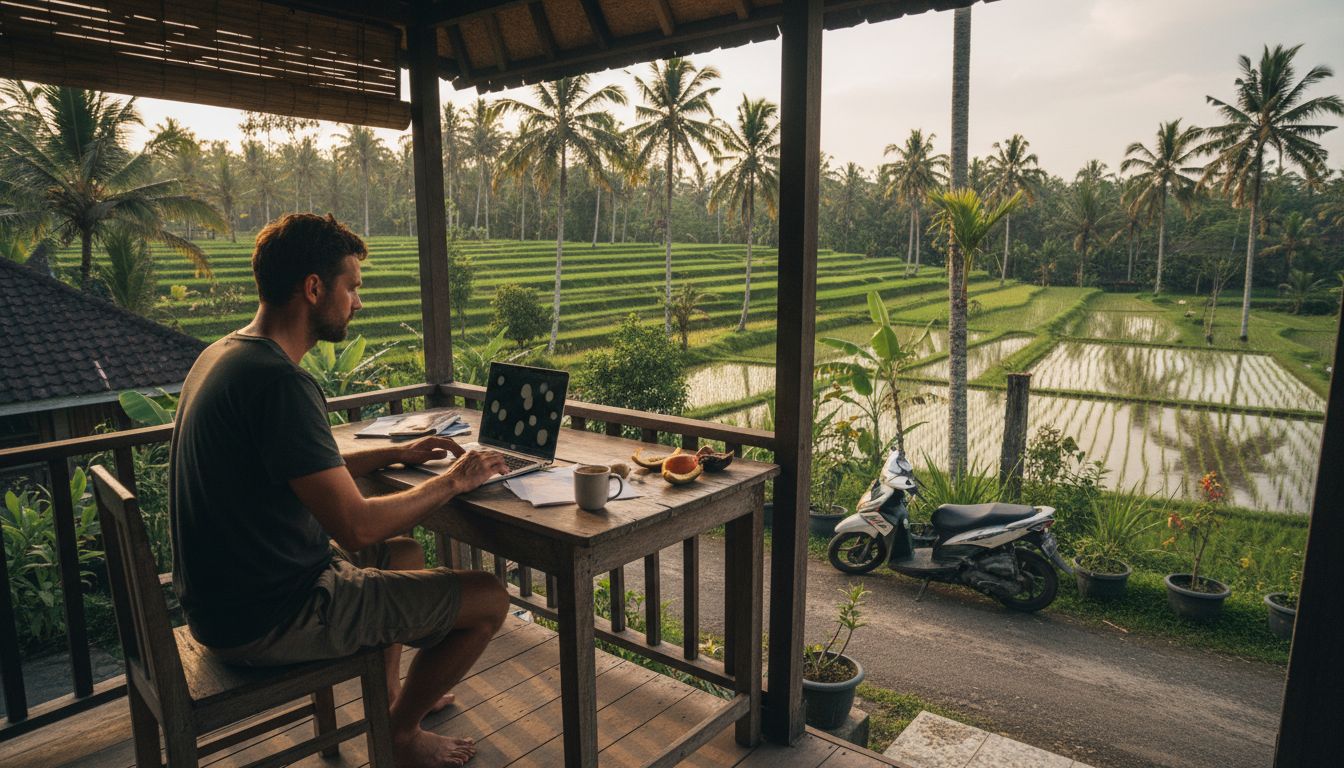
Bali
Indonesia's long-stay destination, and now one with a real residence permit behind it — for the minority who clear the income bar.
- Best months
- Apr – Oct
- Wettest
- Nov – Mar
- Getting around
- Scooter
- Areas
- 5 compared
- Visa
- Country-issued
- Cost data
- Not yet sourced
The Bali guide
Bali is not a city and the choice here is not a neighbourhood — it is which part of an island roughly the size of Cornwall you live on, and the answers are an hour apart in traffic that gets worse every year. Canggu and Ubud are forty kilometres and two entirely different lives apart. Getting that choice wrong is the most common reason people leave after two months, and it is a much more consequential decision than anything on the cost table.
Indonesia issues the permission to be here, not Bali — the city does not change what you are allowed to do. Indonesia visa programmes →
Which part of Bali
5 areasCanggu
South-west coastWhere most people land and the easiest place to have a life within a week: the highest concentration of coworking, cafes and other foreigners anywhere in Indonesia.
The catch: It is a building site with a traffic problem — the shortcut lanes are gridlocked at rush hour, construction is constant and audible, and a lot of people who came for Bali find they moved to a version of it that could be anywhere.
- Cost, relative
- Among the highest
- Getting around
- Scooter. Traffic is the cost.
- Who is there
- Remote workers, surfers, young
- Nights
- Loudest on the island
Ubud
Inland, centralPick it for the quiet, the greenery and a slower, more settled community. It is the other pole of Bali and the one people move to when Canggu wears them out.
The catch: No beach, meaningfully more rain and humidity than the coast, and every trip to the airport or the sea is a real journey. The traffic through the centre is worse than its reputation suggests.
- Cost, relative
- Below Canggu
- Getting around
- Scooter. Narrow roads.
- Who is there
- Long-stayers, wellness, families
- Nights
- Quiet, ends early
Seminyak & Kerobokan
South, coastalPick it for restaurants, services and the shortest airport run of the five. It is the most developed and the most functional part of the island.
The catch: It is the most touristed part of Bali and the least likely to produce a community — plenty of people have a very comfortable and quite lonely six months here.
- Cost, relative
- Highest of the five
- Getting around
- Scooter, some walking
- Who is there
- Tourists, established expats
- Nights
- Busy, restaurant-led
Sanur
East coastPick it for calm: a reef-protected lagoon rather than surf, a flat seafront path you can actually walk or cycle, and the best hospital access on the island.
The catch: Widely and not unfairly described as dull if you are under thirty-five — far fewer places to work from, and the scene you came for is on the other coast.
- Cost, relative
- Below Seminyak
- Getting around
- Walkable seafront, scooter
- Who is there
- Retirees, families, older expats
- Nights
- Quiet
Uluwatu & the Bukit
Southern peninsulaPick it for the surf and the landscape, which are the best on the island and not close. Newer, emptier, and dramatic in a way the rest of Bali is not.
The catch: Everything is far from everything else, the peninsula is limestone with a real dry-season water-supply problem, and a supermarket run is a twenty-minute ride rather than a walk.
- Cost, relative
- Wide spread
- Getting around
- Scooter mandatory. Long rides.
- Who is there
- Surfers, newer arrivals
- Nights
- Scattered, ends early
The choice is which coast, not which street
On a map Bali looks small. In practice the island is defined by roads that have not grown with it: Canggu to Ubud is about forty kilometres and can take ninety minutes, and Canggu to Uluwatu is worse. People routinely plan a life that spans two of these areas and quietly stop doing one of them by week three.
So pick the one where you want to be most days, and treat the rest of the island as somewhere you visit. The five above are genuinely different places, and the difference between them is far larger than the difference between two neighbourhoods in any city on this site.
A scooter is not optional. There is no usable public transport, ride-hailing is actively restricted in some areas by local driver associations, and the island assumes you ride. That single fact rules Bali out for some people, and it is better to know it now than after a flight.
Where people work, and who you will meet
Bali has the densest coworking scene in Southeast Asia and the most established one — it is concentrated in Canggu and Ubud, and it is the reason the island still holds its reputation despite everything below. Cafes are openly laptop-friendly in a way they are not in most of Asia.
The community is unusually easy to enter and unusually transient. Meeting people here takes almost no effort, which is genuinely rare — and a large share of them leave within three months, which is the part nobody mentions. People who stay tend to end up in Ubud or Sanur with a smaller, more settled group.
What is genuinely bad here
Traffic and development, which are the same problem. The south of the island is being built on faster than its roads, water and waste systems can absorb, and the version of Bali in the photographs is receding. This is the honest reason a lot of long-term residents have left.
The wet season, from roughly November to March, is heavier than people expect: daily rain, real humidity, and a west-coast monsoon current that pushes marine rubbish onto the beaches in volumes that make the news most years. It is not a wash-out — most days still have sun — but it is not the dry-season island either.
Then the small things that are large in aggregate: power cuts, water supply problems on the Bukit in dry season, stomach illness in the first weeks, and road injuries. Plan for Nyepi too — for one day each March the entire island shuts down, including the airport, and you are expected to stay indoors. It is genuinely worth experiencing, and it is not something to book a flight through.
Healthcare here, specifically
Bali has good private clinics and hospitals for routine care — BIMC and Siloam are the names foreigners use, in Kuta, Nusa Dua and Denpasar, with English spoken and international standards. For anything ordinary you will be treated well and billed immediately, in full, before you leave.
Serious cases are a different story, and this is the fact that should shape how you insure yourself. Complex trauma, cardiac events and anything needing specialist intensive care are commonly stabilised here and evacuated to Singapore, which is the nearest centre of that standard. An air ambulance to Singapore is a five-figure bill and it is the single most expensive thing that can happen to you on this island.
That is why medical evacuation cover matters more in Bali than almost anywhere else we write about, and why it is worth checking the evacuation limit on a policy rather than the headline coverage number. The commonest claim, by a distance, is a scooter injury — and riding without the correct licence and an International Driving Permit is what voids it.
The visa is real, and the bar is $60,000
The E33G remote worker KITAS is a proper residence permit, not a long tourist stay, and it asks for an employment contract with a company outside Indonesia plus an annual income paid into a personal account. The current figures and conditions are on the Indonesia record linked from this page, dated and sourced, rather than restated here where they would go stale.
Two things about it catch people. It is written around employees, so a freelancer with several clients may simply not hold the documents it asks for. And the restriction runs hard the other way: no Indonesian employer, no Indonesian clients, nothing sold inside the country. Not one local customer.
It also tests how you are paid, not only what you earn — into a personal account, evidenced by statements. People routed through payment platforms or paying themselves through their own company routinely cannot produce the document, and find out late; if that is you, sort the account before you apply.
Below the bar, the answer has not changed in five years — a tourist e-visa, or a social-cultural route through an agent. Both work, both are legal, and neither is residence. You pay to renew your right to be here on a schedule, indefinitely, and nothing accrues.
The 183-day rule may not be the test that catches you
Almost everyone plans their year around a day count, because that is how the rest of the region works. Indonesia has a day count. It also has a second trigger with no days attached: being present during a fiscal year and intending to reside in Indonesia.
A KITAS is a residence permit. Applying for one and living on it is the kind of thing that evidences intent. So the practical question may not be whether you crossed day 184 — it may be that the permit answered the question before you started counting.
We are stating the trigger, not predicting your outcome. How intent gets assessed in a particular case, and how your home country's treaty interacts with it, is exactly where general guidance stops being worth anything and a local accountant starts.
Why our Bali costs are ranges, and why some lines are blank
Bali is the hardest place on this site to cost honestly. Rent spans a genuinely enormous range — a long lease negotiated locally in Indonesian and a villa listed in English are different markets for the same building — and the listing sites that would settle it publish in the currency and the language aimed at whoever is searching.
So each line below carries its source and the date we checked it, and any line we cannot stand behind says so rather than showing a number. A blank is a real answer here. The sites that fill every cell are not better sourced than we are; they are just willing to publish an average of numbers they did not check either.
If you live here, the blanks are where a correction is worth the most — and the box under the table is where to put one.
What a month costs
2 unsourcedBali has the widest genuine spread of any city we cover, and the two markets barely overlap: a yearly lease negotiated locally in Indonesian and a villa listed in English are different prices for the same building. Publishing one range across both would describe neither. Pending a source that separates them.
Pending a direct check against operator pricing pages rather than a round-up quoting them.
2 of these lines have no figure yet.
That is deliberate. We publish a cost line when we have a source we would stand behind and a date we checked it, and leave it blank when we don't — rather than averaging numbers we never verified, which is what the figure you'll find elsewhere usually is. If you live in Bali, these gaps are where a correction is worth the most.
Live in Bali? Tell us what you actually pay.
One field is enough. No account, no email — we're collecting figures, not reviews, and a real number from one resident beats an average scraped from nobody.
Practical
A scooter, effectively without exception — there is no public transport worth the name and ride-hailing is restricted or unwelcome in some areas by local driver associations. Carry your home licence and an International Driving Permit: riding without them voids the medical section of most travel policies, and scooter injuries are the single commonest claim here.
Low violent crime and the day-to-day risks are mundane: the road, the surf, and phone snatching in the busy southern strips. The water is the one people underestimate — rip currents on the west-coast beaches are serious and the beaches are largely unpatrolled outside the main breaks.
Indonesian Rupiah. Use bank-branded ATMs inside bank premises rather than the standalone machines in convenience stores, which are where card skimming reports cluster. Cards work in the tourist-facing south and much less reliably elsewhere.
Fibre reaches Canggu, Seminyak, Sanur and central Ubud and is genuinely good where it lands, but coverage is address-by-address rather than area-wide and power cuts are routine. Most people who work here keep a mobile data plan as a live backup rather than as a fallback they never test.
Common questions
Which part of Bali should I live in?
Canggu if you want the largest remote-work community and the easiest first month, at the price of traffic, construction and noise. Ubud for green and quiet, forty minutes from any beach. Sanur for calm water, flat walkable streets and the best hospital access, which is why it skews older. Seminyak for restaurants and the shortest airport run. Uluwatu for the surf, if you accept that everything is a long ride away. They are an hour apart in traffic and they are genuinely different lives.
Do I need a scooter to live in Bali?
Effectively yes. There is no usable public transport, ride-hailing is restricted or unwelcome in some areas by local driver associations, and the island assumes you ride. If you will not ride a scooter, Bali is a harder place to live than its reputation suggests. If you do ride, carry your home licence and an International Driving Permit — riding without them is not just a fine, it voids the medical cover on most travel and nomad policies, and scooter injuries are the commonest claim on the island.
What is healthcare like in Bali?
Good for routine care and limited for serious cases. BIMC and Siloam are the private hospitals foreigners use, English is spoken, and you are billed in full before you leave. Anything complex — major trauma, cardiac events, specialist intensive care — is commonly stabilised in Bali and evacuated to Singapore, and an air ambulance there is a five-figure bill. Check the medical evacuation limit on any policy you buy for Bali, not just the headline coverage figure.
Can I legally live in Bali as a remote worker?
Yes, on the E33G remote worker KITAS, which is a genuine one-year residence permit for remote employees of companies outside Indonesia. It has a substantial income requirement and asks for an employment contract, which makes it harder for freelancers with multiple clients than for salaried remote employees. The current figures are on the Indonesia record linked from this page, with the date they were last checked.
What do people use if they don't qualify for the E33G?
A tourist e-visa, extendable, or a social-cultural route arranged through an agent — both common and well-worn in Bali. Both are legal and both are temporary stay rather than residence: no status accrues, no path to permanence opens, and you keep paying to renew for as long as you live here.
Will I pay Indonesian tax if I live in Bali?
Possibly, and the day count is not the only test. You are tax resident if present more than 183 days in any twelve-month period, or if you are present during a fiscal year and intend to reside in Indonesia — and holding a residence permit speaks to intent. Residents are taxed on worldwide income. There is a four-year territorial regime for foreigners with certain expertise, but it carries conditions the summaries drop and Indonesia has published nothing on whether E33G holders can use it.
How much does it cost to live in Bali per month?
Bali has the widest genuine spread of any place we cover, because a lease negotiated locally and a villa listed in English are different markets for the same property. We publish ranges with the source and date for each line, and leave a line blank where we have no figure we would stand behind rather than averaging numbers we did not check.