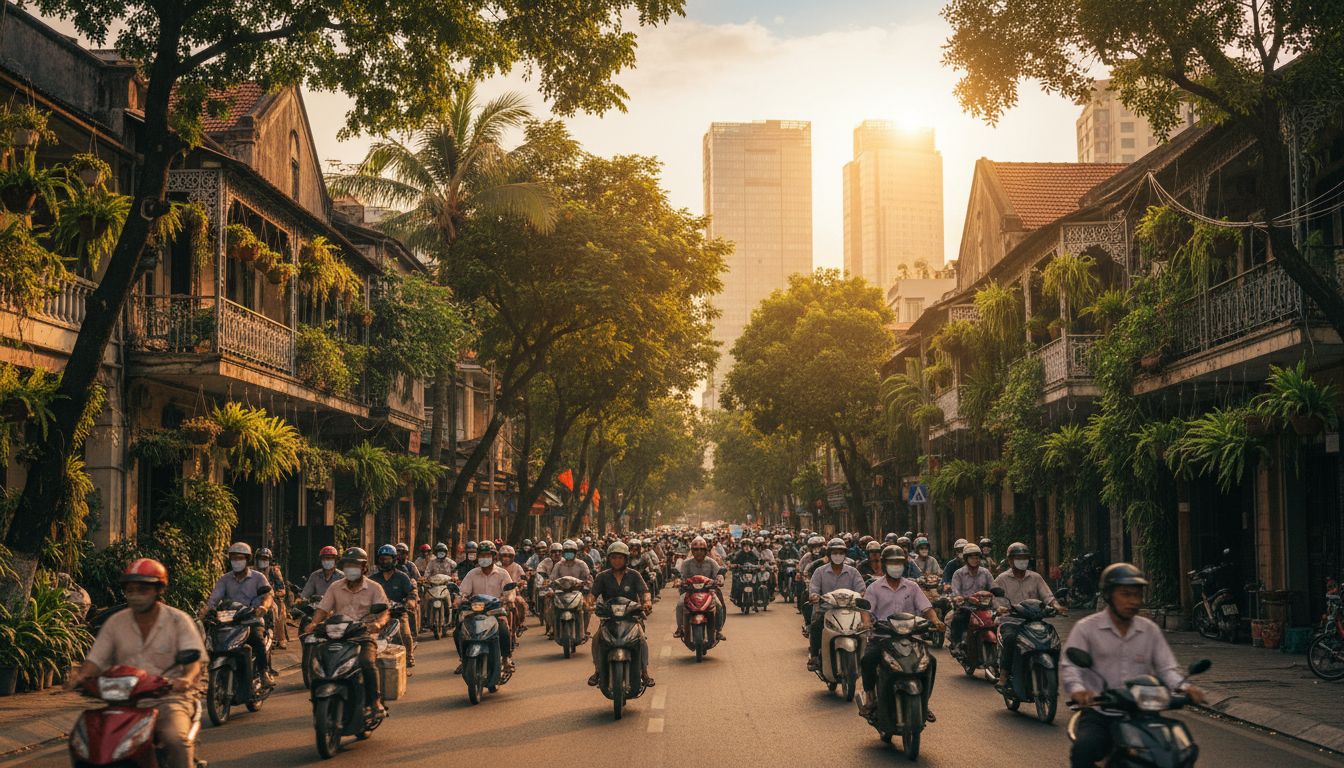
Ho Chi Minh City
Vietnam's working city — the clients, the flights and the hospitals are all here, and so is the traffic, the air and a pace with no quiet season.
- Best months
- Dec – Mar
- Wettest
- May – Nov
- Getting around
- Scooter, Grab, one metro
- Neighbourhoods
- 5 compared
- Visa
- No long-stay route
- Cost data
- Not yet sourced
The Ho Chi Minh City guide
Ho Chi Minh City — Saigon to almost everyone who lives here — is where Vietnam actually works. The clients, the flights, the hospitals and the professional network are here and nowhere else in the country is close. What you trade for that is a city with no quiet season: the noise, the traffic and the air do not let up in the way Da Nang's do, and the district you pick is largely a decision about how much of that you want between you and your front door.
Vietnam issues the permission to be here, not Ho Chi Minh City — the city does not change what you are allowed to do. Vietnam visa programmes →
Which neighbourhood
5 areasDistrict 1
The centreThe default for a first stay and for anyone whose work is in the city. Offices, the airport run, the metro terminus and most of what a visitor thinks of as Saigon, all walkable.
The catch: The noise and traffic are at their worst here and there is almost no green space — it is a fine place to work and a hard place to rest, which is why many people move out after their first lease.
- Cost, relative
- Highest in the city
- Getting around
- Walkable. Metro terminus.
- Who is there
- Business expats, short-stayers
- Nights
- Loudest, and late
District 3
Next door, north-west of D1Our value pick for the centre. Tree-lined streets, serious cafe culture, and rents below District 1 while staying inside the same commute.
The catch: Fewer of the services aimed at foreigners, older buildings whose quality varies a lot unit to unit, and no metro stop of its own.
- Cost, relative
- Below District 1
- Getting around
- Walkable, then a bike
- Who is there
- Vietnamese professionals, long-stayers
- Nights
- Local and unhurried
Binh Thanh
East, between D1 and Thao DienPick it for new-build towers at prices neither the centre nor Thao Dien offers, on the corridor Metro Line 1 runs along — the district whose case changed most in the last two years.
The catch: Enormous and inconsistent — a tower with a metro stop and a lane twenty minutes' walk away are very different places, and only one of them is what people mean by Binh Thanh.
- Cost, relative
- Below Thao Dien
- Getting around
- Metro corridor, then a bike
- Who is there
- Young professionals, mixed
- Nights
- Busy near the river
Thao Dien
Across the river, in Thu Duc CityPick it for space, trees, international schools and a genuine family community — the closest thing Saigon has to a suburb, and the reason people with children choose the city at all.
The catch: You can live here for a year and barely engage with Vietnam, prices are quoted accordingly, and the trip into the centre is the thing you will do less often than you promise yourself.
- Cost, relative
- Highest outside D1
- Getting around
- Metro stop. Bike for the rest.
- Who is there
- Families, established expats
- Nights
- Restaurant-led, quiet
District 7 & Phu My Hung
South, across the channelPick it for order: a properly master-planned district with pavements, parks and space, plus large settled Korean and Taiwanese communities and good international schools.
The catch: No metro and a long, unpleasant commute into the centre at rush hour. It is calm and it is separate, and people who need the city daily regret it.
- Cost, relative
- Wide spread
- Getting around
- Bike or car. No metro.
- Who is there
- Korean and Taiwanese families
- Nights
- Quiet
The metro finally opened, and it changes where you would live
Metro Line 1, from Ben Thanh in District 1 out through Binh Thanh and Thao Dien toward Suoi Tien, began carrying passengers at the end of 2024 after more than a decade of delays. It is one line, not a network, and most of the city is still nowhere near it.
But it runs along the exact corridor foreigners live on, and that is the point. Thao Dien and the riverside stretch of Binh Thanh went from 'across the river, plan for traffic' to a fixed, predictable trip into the centre — which is the single biggest change to this city's liveability in years and the thing older guides are all still wrong about.
Everywhere else, the honest answer is a scooter or Grab, and Grab is cheap enough here that many people never buy a bike at all. That option does not exist in Da Nang, Phuket or Bali, and for anyone who does not want to ride, it is a genuine reason to pick this city over those.
Where people work, and who you will meet
This is the professional city. The client base, the agencies, the startups, the international companies and the deepest coworking market in Vietnam are all here, and someone whose work involves other people rather than just a laptop will find Saigon does something Da Nang cannot.
It is also several communities that barely touch: business expats on packages around District 1, families in Thao Dien and District 7, a large Korean and Taiwanese population in the south, a young Vietnamese professional scene in District 3 and Binh Thanh, and remote workers scattered through all of it. Nobody meets people by accident here the way they do in An Thuong — you have to pick a scene and show up.
What is genuinely bad here
The relentlessness, which sounds soft and is the reason most people eventually leave. Saigon has no quiet season and very little green space: the noise, the construction and the traffic run at the same level in March and in October, and there is nowhere in the centre to get away from it without leaving the city.
The air, which is traffic-driven rather than seasonal-burning like Chiang Mai's, so it does not clear for most of the year the way northern Thailand's does. Combined with heat and humidity that barely vary, it makes walking distances that look reasonable on a map something you stop doing by month two.
Then flooding. Parts of the city sit at or below the level of the tidal river, and heavy rain arriving with a high tide puts water into streets across Binh Thanh, District 7 and Thu Duc several times a year. It is routine rather than dramatic, and it is worth asking about a specific street before signing rather than after.
Healthcare here, specifically
This is Vietnam's best city for medical care by a clear margin, and it is where the rest of the country comes. The international hospitals used by foreigners — FV Hospital in District 7 and the Vinmec and Columbia Asia facilities among them — handle complex surgery and specialist care to a standard the rest of Vietnam does not offer. Our Da Nang page names this city as where its serious cases go.
That does not make it Bangkok or Singapore. For the most complex cases and for some specialist oncology and cardiac work, evacuation to one of those is still the realistic route, and an air ambulance is a five-figure bill. The practical read: routine and serious care are both well handled here, and the tail is what insurance is for.
Private hospitals bill immediately and in full unless your insurer direct-bills, so check that rather than the headline coverage number. And check motorbike use is covered at all — Vietnam's road statistics are poor, and riding without a licence valid for the bike plus an International Driving Permit voids the medical section of most policies.
There is still no long-stay visa
Vietnam has no digital nomad visa and no retirement visa. A package was proposed in 2025 and was still a proposal when we last checked the record; the pages ranking for those searches are agencies selling something else under the name. The full version of that argument is on the Vietnam guide linked from this page.
What it means here specifically: the business-visa route arranged through a sponsoring company is more available in Saigon than anywhere else in the country, because this is where the companies are — which is why the foreign population here skews longer-term and more settled than Da Nang's. It is still not residence, and it still depends on an arrangement rather than a right.
Plan the stay you can actually hold. The routes are listed below, read live from our records rather than summarised here, because summarised visa facts are how the rest of the internet gets them wrong.
The 183-day line, and the trap that is not the day count
Vietnam treats you as tax resident at 183 days in a calendar year or in any twelve consecutive months from arrival — note the second one, because it does not reset on 1 January the way people assume.
There is a second trigger independent of the count: having a permanent residence in Vietnam, which includes a leased property held for long enough in the tax year. A long lease on a District 1 apartment can therefore matter to your tax position regardless of how many days you actually spent in the country — and long leases are more common here than in Da Nang, so this catches more people in this city.
Residents are taxed on worldwide income on a progressive scale. We are stating the triggers, not predicting your outcome — how they interact with your home country's treaty is where general guidance stops being worth anything and a local accountant starts.
What we have not sourced, and why the rows are blank
Vietnam publishes no official rental series, and Ho Chi Minh City splits harder than any other city on this site: a serviced-apartment tier quoted to foreigners in dollars, and a local tier quoted in dong through direct contact and Facebook groups, commonly a large gap apart for the same building.
Publishing one number would mean picking one of those two markets and calling it the city. That is what the cost-of-living sites do here, and they do not tell you which one they picked — it is the foreigner tier, because that is the one that gets listed.
So the rows publish at five dated resident submissions, each naming its district, and the box under the table is where they go. District is not optional here: District 3 and Thao Dien are not the same market and averaging them would produce a number true of neither.
What a month costs
2 unsourcedBlank. Vietnam publishes no official rental series, and Ho Chi Minh City's market splits sharply between the serviced-apartment tier quoted to foreigners in dollars and the local tier quoted in dong through direct contact and Facebook groups — commonly a large gap for the same building. Publishing a single figure would be picking one of those two markets and calling it the city. Publishing at five dated resident submissions, each naming its district.
Ho Chi Minh City has the deepest coworking market in Vietnam and the widest spread of rates, from local operators to international chains in District 1 towers. A single scraped figure would be meaningless across that range. Publishing at five dated submissions.
2 of these lines have no figure yet.
That is deliberate. We publish a cost line when we have a source we would stand behind and a date we checked it, and leave it blank when we don't — rather than averaging numbers we never verified, which is what the figure you'll find elsewhere usually is. If you live in Ho Chi Minh City, these gaps are where a correction is worth the most.
Live in Ho Chi Minh City? Tell us what you actually pay.
One field is enough. No account, no email — we're collecting figures, not reviews, and a real number from one resident beats an average scraped from nobody.
Practical
A scooter or Grab, and Grab is cheap enough here that plenty of people never buy a bike — which is not true of Da Nang, Phuket or Bali. Metro Line 1 opened at the end of 2024 and covers one corridor rather than the city. If you do ride, carry your home licence and an International Driving Permit: without them the medical section of most travel policies does not pay.
Low violent crime and a real, persistent problem with phone and bag snatching from passing motorbikes — this is the one thing locals warn newcomers about and it is not folklore. Do not use a phone at the kerb or wear a bag on the street side, and the risk drops close to nothing.
Vietnamese Dong. QR payment is widespread and often preferred, but cash still matters more than in Thailand. Foreign-card ATM fees vary a lot by bank, so find one that suits you rather than using whichever machine is nearest.
Cheap, fast, quick to install. The known weakness is national rather than local: Vietnam's undersea cables have a long record of faults, and when one breaks, links to servers abroad slow badly for days while domestic speed looks fine. Keep a mobile backup you have actually tested.
Common questions
Which district of Ho Chi Minh City should I live in?
District 1 if your work is in the city and you want everything walkable, at the highest prices and the most noise. District 3 is our value pick — ten minutes out, cheaper, tree-lined and far more Vietnamese. Binh Thanh is the corridor Metro Line 1 runs along and the district whose case improved most recently. Thao Dien across the river is leafy, family-oriented and the least Vietnamese part of the city. District 7 is planned and calm and a long way from the centre.
Does Ho Chi Minh City have a metro?
Yes, since the end of 2024. Line 1 runs from Ben Thanh in District 1 out through Binh Thanh and Thao Dien toward Suoi Tien, after more than a decade of delays — so guides written before 2025 are wrong about this. It is one line rather than a network and most of the city is nowhere near it, but it happens to run along the corridor foreigners live on, which is why Thao Dien and riverside Binh Thanh are more practical than they used to be.
Do I need a scooter in Ho Chi Minh City?
No, and that makes it unusual among the cities we cover. Grab is cheap and everywhere, Metro Line 1 covers the main expat corridor, and plenty of residents never buy a bike — an option that does not really exist in Da Nang, Phuket or Bali. If you do ride, carry your home licence and an International Driving Permit, because riding without them voids the medical cover on most travel and nomad policies.
Is Ho Chi Minh City or Da Nang better for remote work?
Da Nang for quality of life, Saigon for work that involves other people. Da Nang is flatter, cheaper, calmer and has better air and a beach. Saigon has the clients, the flights, the professional network, the deepest coworking market and by far the best hospitals — and it has no quiet season. If your work is a laptop and nothing else, Da Nang usually wins. If it involves meetings, Saigon is the only real answer in Vietnam.
Is there a digital nomad visa for Vietnam?
No. Vietnam has no digital nomad visa and no retirement visa, despite the search volume for both. A package of long-stay visas was proposed in 2025 and remained a proposal when we last checked the record. In practice people live here on a 90-day e-visa or on a business visa arranged through a sponsoring company — which is more available in Ho Chi Minh City than anywhere else in Vietnam, because this is where the companies are.
When do I become tax resident in Vietnam?
At 183 days in a calendar year OR in any twelve consecutive months from arrival — the second does not reset on 1 January the way people assume. There is also a trigger independent of the day count: having a permanent residence, which can include a leased property held long enough in the tax year. Long leases are common in Ho Chi Minh City, so this catches more people here than in Da Nang. Residents are taxed on worldwide income.