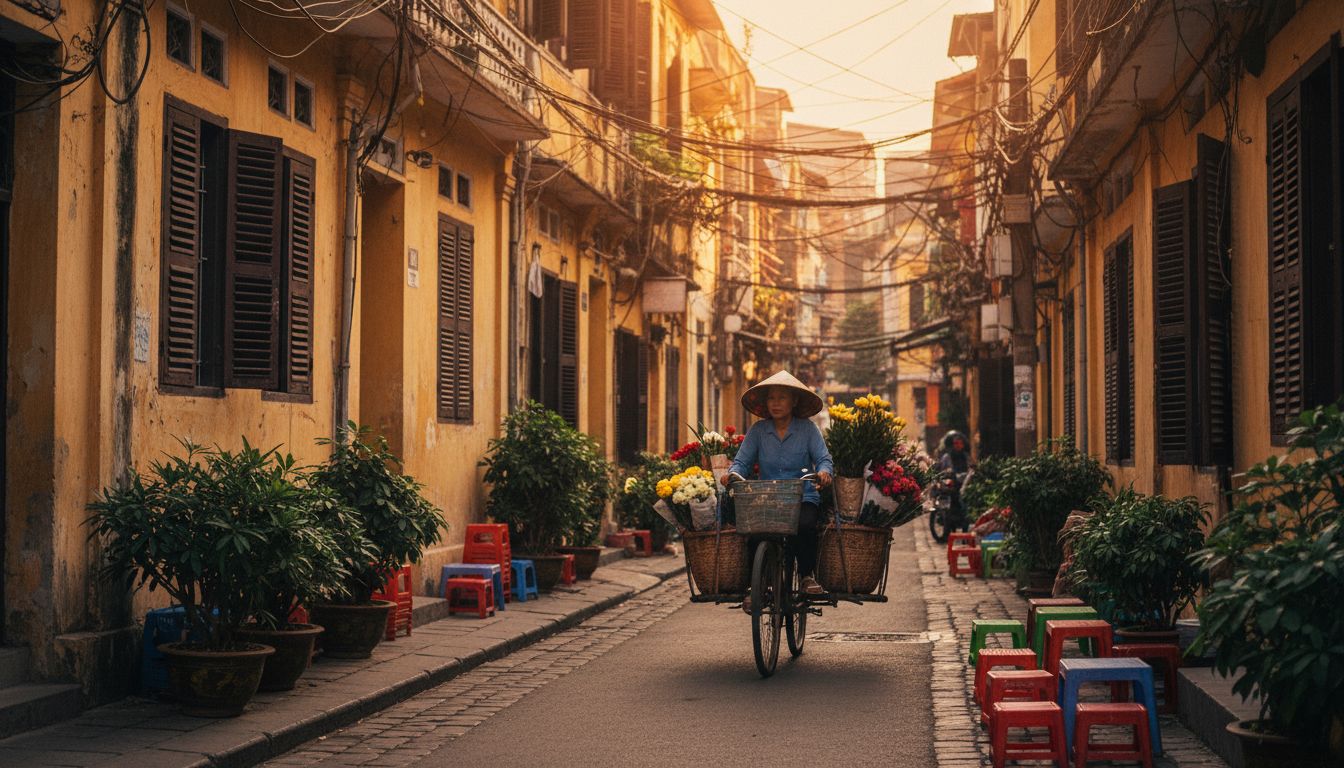
Hanoi
Vietnam's oldest and most Vietnamese-facing city — cheaper than Saigon for the same flat, colder than anyone expects, and holding the worst air of the three.
- Best months
- Sep – Nov, Apr – May
- Worst air
- Nov – Mar
- Getting around
- Scooter or Grab
- Neighbourhoods
- 4 compared
- Visa
- No long-stay route
- Cost data
- Not yet sourced
The Hanoi guide
Hanoi is where you live in Vietnam rather than beside it. It is older and denser than Saigon, meaningfully cheaper for the same flat, and far more Vietnamese-facing — the foreign population is smaller and less insulated, which is the whole appeal to the people who choose it. Two things catch almost everyone: it gets genuinely cold from November, in a way nobody expects of Vietnam, and the worst air of the year arrives in the same months.
Vietnam issues the permission to be here, not Hanoi — the city does not change what you are allowed to do. Vietnam visa programmes →
Which neighbourhood
4 areasTay Ho
North, around West LakeWhere most foreigners live and the easiest landing: lakeside streets, international schools, the widest choice of apartments, and space that the rest of the city genuinely does not have.
The catch: It is the least Vietnamese part of Hanoi and priced accordingly, and it is far enough north that the Old Quarter — the reason many people picked this city — becomes a trip rather than a walk.
- Cost, relative
- Highest in the city
- Getting around
- Bike needed. Spread out.
- Who is there
- Foreigners, families, diplomats
- Nights
- Restaurant-led, quiet
Ba Dinh
Centre-west, the government quarterOur balance pick. Leafy, orderly and central, sitting between Tay Ho and the Old Quarter with easy reach of both and rents below the lake.
The catch: Quieter than it looks on a map — the government quarter empties in the evening, and it has less street life than either neighbour.
- Cost, relative
- Below Tay Ho
- Getting around
- Walkable, then a bike
- Who is there
- Diplomats, Vietnamese professionals
- Nights
- Quiet
Hoan Kiem & the Old Quarter
The historic centrePick it to be inside the Hanoi people mean when they say Hanoi: thousand-year-old lanes, street food at every door, and everything within walking distance for once.
The catch: Noise, crowds and tourist traffic that never stop, buildings that are old in the difficult sense as well as the beautiful one, and almost nowhere to park anything.
- Cost, relative
- Mid, and varies hugely
- Getting around
- Genuinely walkable
- Who is there
- Vietnamese residents, tourists
- Nights
- Loud and late
Cau Giay & Nam Tu Liem
West, newer districtsPick it for new-build apartments, lifts that work and reliable services at rents well under the centre — this is where Hanoi's young professionals actually live.
The catch: Modern in a way that could be any Asian city — you moved to Hanoi and this is the part with the least of it, and the centre is a real commute at rush hour.
- Cost, relative
- Lowest of the four
- Getting around
- Bike. Metro corridor.
- Who is there
- Vietnamese professionals, students
- Nights
- Local, low key
Hanoi has a winter, and nobody plans for it
This is the fact that surprises people most and the one guides bury. From November to March northern Vietnam is genuinely cold — not tropical-cool, cold — damp, grey and often without sun for days at a stretch. Hanoi sits far enough north that it gets a real winter, and Vietnamese buildings are built to shed heat rather than hold it.
The practical consequence is that flats have no central heating, walls and floors are tile and concrete, and the damp gets into everything. People who live here well run a dehumidifier and a heater and treat both as normal running costs — which is a line no rent figure includes and one reason our cost rows stay blank.
It also collapses the swimming-and-motorbiking version of Vietnam for a third of the year. If the mental image that brought you to the country is warm, Hanoi delivers it from roughly April to October and something quite different in between.
The worst air of the three, and it arrives with the cold
Hanoi has the worst air quality of the three Vietnamese cities on this site, and it is worst from November to March. The mechanism is the same one that ruins Chiang Mai's February: cool-season temperature inversion traps traffic emissions, industry and regional agricultural burning over the city, and the Red River delta has no wind to clear it.
Readings during the bad weeks put Hanoi among the more polluted capitals in the world, and the timing is the cruel part — the months you would spend indoors anyway because of the cold are the months the air is worst. Anyone with asthma or young children should treat this as a planning constraint rather than a footnote.
The rest of the year is unremarkable for a city this size, and September to November before the inversion sets in is the genuinely lovely stretch everyone who loves Hanoi is thinking of.
Where people work, and who you will meet
Smaller and quieter than Saigon's scene, and more weighted toward people who live here than people passing through: teachers, embassy and NGO staff, long-settled residents, and a Vietnamese professional city that is easier to enter here than in Ho Chi Minh City. Coworking exists around Ba Dinh, Hoan Kiem and Tay Ho and is thinner than the south's.
The trade against Saigon is straightforward. Fewer clients, fewer flights, a smaller professional network — and a city with far more character, lower rents and a foreign community that is not sealed off from the country it lives in. People choosing Hanoi over Saigon are usually choosing exactly that, and they know what it costs them.
Healthcare here, specifically
Good for routine care. Hanoi has international clinics and private hospitals used to treating foreigners, with English available, and everyday illness or a minor injury is handled competently and inexpensively.
For serious cases the realistic route is Ho Chi Minh City's international hospitals, or evacuation to Bangkok or Singapore — the same tail our Da Nang page describes, and an air ambulance to either is a five-figure bill. Hanoi is the capital but Saigon is Vietnam's medical centre, which is not the intuition most people arrive with.
So check the evacuation limit on a policy rather than its headline coverage figure, and check that motorbike use is covered at all — Vietnam's road statistics are poor, and riding without a licence valid for the bike plus an International Driving Permit voids the medical section of most policies.
There is still no long-stay visa
Vietnam has no digital nomad visa and no retirement visa. A package was proposed in 2025 and was still a proposal when we last checked the record; the pages ranking for those searches are agencies selling something else under the name. The full version is on the Vietnam guide linked from this page.
What it means in Hanoi specifically: the sponsored-business-visa route runs through companies, and there are fewer of them here than in Saigon — but the embassy, NGO and international-school employment that does exist here comes with proper sponsorship attached. The foreign population skews toward people whose paperwork is somebody's job, which is why it feels more settled than Da Nang's despite the same national rules.
Plan the stay you can actually hold. The routes are listed below, read live from our records rather than summarised here, because summarised visa facts are how the rest of the internet gets them wrong.
The 183-day line, and the trap that is not the day count
Vietnam treats you as tax resident at 183 days in a calendar year or in any twelve consecutive months from arrival — note the second, because it does not reset on 1 January the way people assume.
There is a second trigger independent of the count: having a permanent residence in Vietnam, which includes a leased property held long enough in the tax year. Hanoi leases run long more often than Da Nang's, so this catches people here who never came close to the day count.
Residents are taxed on worldwide income on a progressive scale. We are stating the triggers, not predicting your outcome — how they interact with your home country's treaty is where general guidance stops being worth anything and a local accountant starts.
What we have not sourced, and why the rows are blank
Vietnam publishes no official rental series, and Hanoi's market runs through Facebook groups and direct landlord contact rather than listing portals — with the same routine gap between the foreigner price and the local price for the same unit that keeps our Saigon row blank.
Hanoi adds a cost the southern cities do not have, and no rent figure anywhere includes it: heating and dehumidifying a flat through the northern winter. A number that ignores four months of that is not a cheaper city, it is an incomplete one.
So the rows publish at five dated resident submissions, each naming its district, and the box under the table is where they go. If you have wintered here, the electricity bill is the number nobody has ever published.
What a month costs
2 unsourcedBlank for the same reason as Ho Chi Minh City's: Vietnam publishes no official rental series, and Hanoi's market runs through Facebook groups and direct landlord contact rather than portals, with a routine gap between the price quoted to a foreigner and the price a Vietnamese tenant pays for the same unit. Hanoi adds one wrinkle the southern cities do not have — heating and dehumidifying a flat through the northern winter is a real running cost that no rent figure includes. Publishing at five dated resident submissions, each naming its district.
Hanoi's coworking market is smaller than Ho Chi Minh City's and clustered around Ba Dinh, Hoan Kiem and Tay Ho, with monthly rates commonly quoted on enquiry. Publishing at five dated submissions.
2 of these lines have no figure yet.
That is deliberate. We publish a cost line when we have a source we would stand behind and a date we checked it, and leave it blank when we don't — rather than averaging numbers we never verified, which is what the figure you'll find elsewhere usually is. If you live in Hanoi, these gaps are where a correction is worth the most.
Live in Hanoi? Tell us what you actually pay.
One field is enough. No account, no email — we're collecting figures, not reviews, and a real number from one resident beats an average scraped from nobody.
Practical
A scooter or Grab. Hanoi's Old Quarter lanes are narrow and chaotic in a way Saigon's boulevards are not, and the two elevated and underground metro lines that have opened cover commuter corridors rather than the districts most foreigners live in. Carry your home licence and an International Driving Permit — without them the medical section of most travel policies does not pay.
Very low violent crime, and noticeably less bag-and-phone snatching than Ho Chi Minh City — this is one of the calmer capitals in the region on the street. The road is the real risk, and the Old Quarter's lanes are where pedestrians and scooters get closest.
Vietnamese Dong. QR payment is widespread; cash still matters more than in Thailand, especially in markets and the Old Quarter. Foreign-card ATM fees vary a lot by bank, so find one that suits you rather than using the nearest.
Cheap, fast and quick to install. The weakness is national rather than local — Vietnam's undersea cables have a long fault record, and when one breaks, links abroad slow badly for days while domestic speed looks fine. Keep a mobile backup you have actually tested.
Common questions
Which district of Hanoi should I live in?
Tay Ho around West Lake if you want space, international schools and the largest foreign community, at the highest prices and the least Vietnamese feel. Ba Dinh is our balance pick — leafy and central, between the lake and the Old Quarter, cheaper than Tay Ho. Hoan Kiem and the Old Quarter put you inside the city everyone comes for, with the noise and crowds that go with it. Cau Giay and Nam Tu Liem to the west are the cheapest, newest and least characterful.
Does Hanoi get cold?
Yes, and it is the thing that surprises people most about Vietnam. From November to March northern Vietnam is genuinely cold, damp and often grey for days at a stretch. Flats have no central heating and are built from tile and concrete to shed heat, so residents run dehumidifiers and heaters through the winter and treat both as normal running costs — an expense no published rent figure for Hanoi includes.
How bad is air quality in Hanoi?
Worst of the three Vietnamese cities we cover, and worst from November to March. Cool-season inversion traps traffic emissions, industry and regional agricultural burning over the Red River delta, which has little wind to clear it, and readings in the bad weeks put Hanoi among the more polluted capitals in the world. The timing compounds it: the months you stay indoors for the cold are the months the air is worst.
Is Hanoi or Ho Chi Minh City better to live in?
Saigon for work, Hanoi for the country. Ho Chi Minh City has the clients, the flights, the professional network and by far the best hospitals, plus warm weather year-round and a metro line through the expat corridor. Hanoi is cheaper for the same flat, has far more character, and its foreign community is much less sealed off from Vietnam — at the cost of a real winter, the country's worst air season, and a smaller professional scene.
Is there a digital nomad visa for Vietnam?
No. Vietnam has no digital nomad visa and no retirement visa, despite the search volume for both. A package of long-stay visas was proposed in 2025 and remained a proposal when we last checked the record — the pages ranking for those terms are agencies selling a different product under the name. In practice people live here on a 90-day e-visa or on a business visa arranged through a sponsoring employer.
When do I become tax resident in Vietnam?
At 183 days in a calendar year OR in any twelve consecutive months from arrival — the second does not reset on 1 January the way people assume. There is also a trigger independent of the day count: having a permanent residence, which can include a leased property held long enough in the tax year. Hanoi leases run long more often than Da Nang's, so this catches people here who never came near the day count. Residents are taxed on worldwide income.